

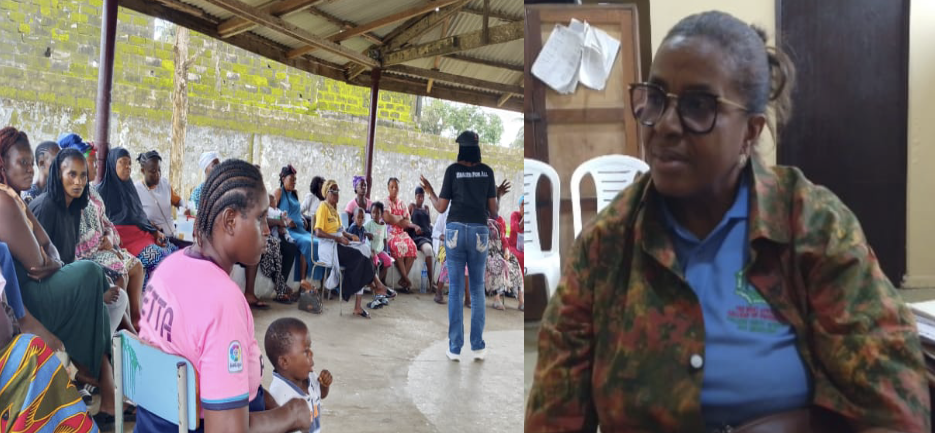
Hundreds of residents of the Borough of New Kru Town on Saturday received free medical consultations, health screenings and public health education as the West African College of Physicians (WACP), Liberia Chapter, launched a major community medical outreach aimed at improving access to essential healthcare while promoting disease prevention.
The outreach, held ahead of the College’s Annual General and Scientific Meeting (AGSM), brought together specialist physicians, resident doctors and public health practitioners who offered free consultations, screening and referrals for patients requiring advanced medical attention.
Leading the initiative was Dr. Musu Duworko, Chairperson of the WACP Liberia Chapter and one of the regional body’s Vice Presidents, who described the outreach as a practical demonstration of the College’s commitment to complementing Liberia’s healthcare system by bringing specialist medical services directly to underserved communities. “We are here to recreate our national visibility and, more importantly, to reach as many people as possible with healthcare services in support of the Ministry of Health,” Dr. Duworko explained.
Unlike conventional medical missions that focus primarily on treatment, Saturday’s exercise combined preventive healthcare, community education and early disease detection—an approach increasingly recognized globally as one of the most cost-effective strategies for improving public health outcomes.
Before commencing medical consultations, physicians, including Dr. John S. Doedeh, Dr. Celina Zayzay, Dr. J. Nulai Kolleh and others, spent over an hour educating residents on diseases that continue to burden Liberia’s healthcare system, including malaria, hypertension, diabetes, antimicrobial resistance (AMR), diarrheal diseases and other communicable illnesses.
Residents were also instructed on proper handwashing, food safety, environmental sanitation and personal hygiene practices, reinforcing the importance of prevention over treatment. According to Dr. Duworko, the educational component is as important as the clinical services. “We talk about personal hygiene, environmental hygiene, disease prevention, food hygiene and outbreak preparedness.
The Ministry of Health is maintaining surveillance against diseases like Ebola, and today we are helping sustain that awareness within the community,” she said. Her remarks reflect a growing consensus among public health experts that community awareness remains one of the strongest defenses against infectious disease outbreaks, particularly in countries vulnerable to epidemics.
Supporting National Goal of Universal Health Coverage Dr. Duworko emphasized that the outreach aligns directly with the country’s national objective of expanding access to essential healthcare services. “The health sector of Liberia aims to ensure access to essential health services across the country, and the West African College of Physicians is partnering with the Ministry of Health to increase that access,” she noted.
For many residents of New Kru Town—one of Monrovia’s densely populated coastal communities—access to specialist medical care remains constrained by financial limitations, transportation costs and overcrowded health facilities. “We are very happy for this outreach. It will help our people,” James Weah, a resident of the township said. “Most of our people do not have the means to seek medical attention and so, this is a huge help.”
Joyce Dugbe added that the outreach was timely, especially as the rainy season comes with a lot of sicknesses. “Because of the rainy season, most of our people are getting sick from cold and other sicknesses. So we are glad that the people are here,” she said.
By bringing physicians into the community free of charge, the WACP sought to bridge part of that gap.
“Everything today is absolutely free,” Dr. Duworko stressed.
She disclosed that previous outreach programs organized by the College have reached between 500 and 2,000 people, depending on turnout and available resources. A recurring theme throughout the outreach was the importance of identifying chronic illnesses before complications develop. Specialist physicians explained that many Liberians unknowingly live with conditions such as hypertension and diabetes for years until serious complications—including stroke, kidney failure or paralysis—occur.
Dr. Odell W. Kumeh, a Fellow of the WACP, said many patients seek medical attention only after diseases have significantly progressed. “It is easier to treat something that is just starting than when it gets worse,” Dr. Kumeh said. “Sometimes people come with blood pressure readings of 240 over 110 and they have no idea anything is wrong. We provide first-line care and immediately refer severe cases to hospitals where they can receive specialist treatment.”
Her observations reflect a persistent challenge confronting health system, where preventive healthcare remains underutilized and routine medical check-ups are uncommon. Another significant message emerging from the outreach was the importance of timely referrals. Dr. Kumeh explained that referral to hospitals should never be interpreted as a physician’s inability to manage a patient but rather as an essential component of quality healthcare.
“It is always in the patient’s best interest to be referred to the most appropriate facility when additional care is needed,” he said.
The outreach also served as an expression of professional service. According to Dr. Benetta Collins Andrews, another Fellow WACP, the initiative represents the College’s commitment to giving back to communities that often struggle to access specialist healthcare. “This is our way of giving back,” she said.
“We know there are people who cannot easily reach hospitals, while others do not realize they should seek medical care until their illnesses become severe. We are here to create awareness and encourage early treatment.”
She stressed that healthcare extends beyond treating illness. “Health is physical, mental and social. Our responsibility is to help people understand that seeking care early can prevent complications later.”
Celebrating Five Decades of Medical Excellence
This year’s outreach also carries symbolic significance.
The West African College of Physicians is commemorating 50 years of regional service, while Liberia’s chapter is marking its own contributions to specialist medical education and healthcare delivery.
Founded on October 23, 1976, the regional College comprises five founding chapters—Liberia, The Gambia, Ghana, Sierra Leone and Nigeria—with a mandate to train specialist physicians across West Africa. Over the years, the local chapter has expanded steadily and now tens of Fellows, many members and physicians in specialist training, reflecting the country’s growing investment in postgraduate medical education through the Liberia College of Physicians and Surgeons (LCPS) and the Liberia Postgraduate
Medical Council.
Dr. Duworko described the anniversary as an opportunity to celebrate decades of developing homegrown specialists. “Our contribution has been ensuring that Liberia has specialist healthcare services delivered by Liberian physicians trained right here at home,” she said. The official anniversary celebrations will continue during the College’s Annual General and Scientific Meeting later this month before joining regional commemorative events scheduled for October in Abuja, Nigeria.
Community Medicine as a Public Health Strategy
Saturday’s outreach illustrates an increasingly important shift in healthcare delivery—from treating illness inside hospitals to preventing disease within communities. Rather than waiting for patients to seek medical care after becoming seriously ill, the WACP initiative places physicians directly where health risks are greatest, combining education, screening and referral in a single intervention.
Public health experts have consistently argued that such outreach programs reduce healthcare costs over time by detecting diseases earlier, improving community awareness and reducing pressure on already stretched hospital systems.
Community-based interventions such as Saturday’s outreach therefore represent an important complement to facility-based healthcare.
As the exercise concluded, Dr. Duworko encouraged residents to take advantage of preventive healthcare services rather than waiting until illnesses become life-threatening. “My message is simple—people should seize opportunities like this to come out and be examined,” she urged. Dr. Kumeh reinforced that appeal with a reminder that every major illness begins as a manageable condition.
“There is no such thing as a small disease or a big disease. Every illness starts small. If we detect it early and manage it properly, we can prevent it from becoming something much more serious.”
The outreach ended with physicians reiterating a message that has become central to modern public health practice: health is everyone’s responsibility, and prevention remains one of the most effective medicines available.