

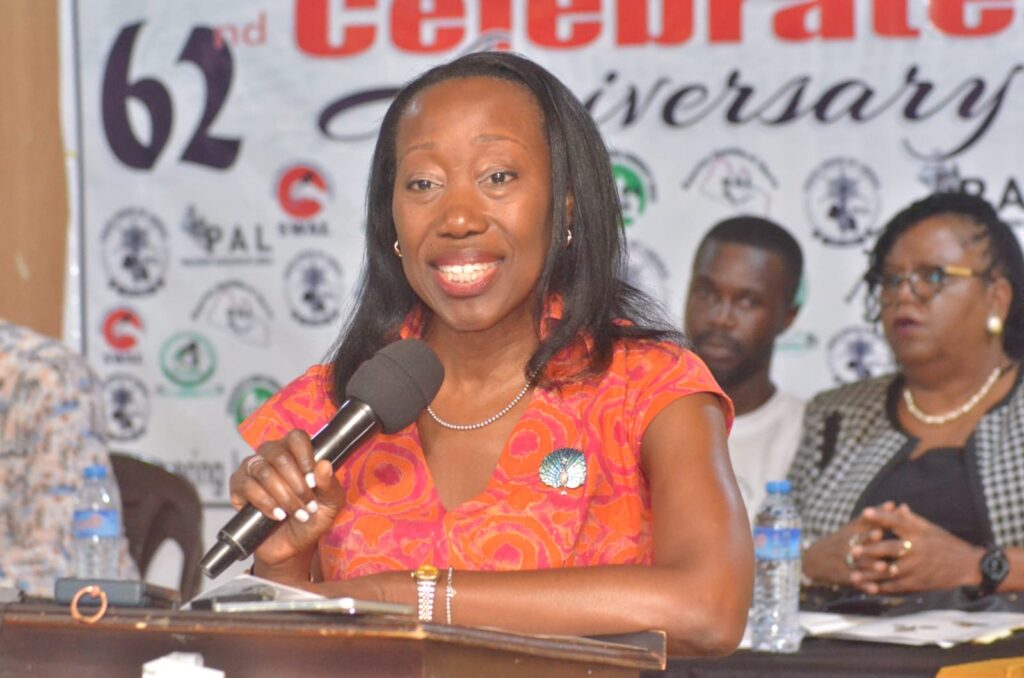
MONROVIA — World Bank Group Liberia Country Manager Georgia Wallen warned that artificial intelligence and social media are making truth harder to distinguish from fiction, and that Liberian journalists will be judged by whether they become more rigorous — or more dispensable.
Wallen spoke at the Press Union of Liberia’s 62nd Anniversary celebration at the Clar Marie Weah Events Hall in Sinkor, saying the information landscape has shifted faster than at any point in the Union’s history.
“The rapid growth of social and new media imposes an even greater responsibility on professional journalists,” she said. “Today, information travels faster than ever before, with new technologies that pose unprecedented opportunities, risks, and demands.”
Wallen said social media and AI tools are spreading rapidly, while accuracy depends on strong local institutions and reliable data systems, as she cited the 2026 World Development Report, The Promise of Artificial Intelligence.
“As it becomes harder to distinguish truth from fiction, journalism will be increasingly challenged to become more reliable, more rigorous and more indispensable,” she said.
She tied that challenge to the World Bank Group’s partnership with Liberia, which focuses on building foundations for more and better jobs — arguing that information accuracy and sound national data systems sit at the center of that agenda.
“You play a key role when your stories reflect public interest and what you hold to be true at heart,” she told the journalists.
Wallen said the answer to the AI-era challenge lies in the profession’s oldest values. She described credibility as “the product of an enduring commitment to truth, transparency and accountability,” pointing to fact-checking, context, accuracy and fairness as the standards that keep journalism relevant.
She cited the World Bank’s 2002 World Development Report, which devoted a chapter to the media’s role in development, and said realizing the media’s potential “requires that media is independent, accountable, and able to provide relevant information and reflect diverse social views.”
Wallen closed by urging Liberian journalists to recognize the weight of their work, noting that local reporters hold an advantage foreign correspondents cannot match.
“Every microphone you hold, every camera you operate, every interview you conduct, and every story you publish has influence and value,” she said. “You are here — on the ground in counties, districts, and communities across this great country.”
She said the voices of “Liberia’s farmers, workers, entrepreneurs, young people, women, children and communities matter; you can help us to hear them.”
Wallen pointed to Liberia’s projected population growth to over 8 million by 2042, based on the 2022 National Population and Housing Census, and asked what investments are needed now to prepare for that future.
“History and research make clear that independent and credible media is not an obstacle to development. It is part of the infrastructure of development,” she said.
Kanubah: A Year of Threats
PUL President Julius Kanubah catalogued a year of arrests, intimidation and legal harassment of journalists — and announced that construction of the Union’s national headquarters will begin within weeks.
Kanubah opened by congratulating journalists, media practitioners, invited guests and the public on the Union’s 62nd anniversary, calling the milestone “no small feat.” He then asked the gathering to observe a moment of silence for fifteen colleagues who died during the year.
Those remembered were Jonathan Browne, Seibo Daniels, D. Ignatius Roberts, Frank Loboe, Samukai Dukuly, Joel N’Gado Bou Jacobs, Amos Mulbah Kornomugie, Daniel Zayzay, James Paykoo, Molley Passawe, Babason Harris, Peter Kieh Doe, Charles Johnson and Ernest Kiazolu.
“May their souls and the souls of all faithful departed rest in peace and may light perpetual continue to shine on them,” Kanubah said.
Tracing the Union’s origins to the 1964 jailing of journalist Stanton Peabody — held in contempt and arrested for a critical article referring to legislators as “radicals” — Kanubah said the struggle that gave birth to the PUL persists six decades later.
Kanubah listed a series of incidents from the past year:
· Rivercess County: Journalists Eric Opa Doue and Methesulah Gaye were arrested and detained for contempt of court and publishing false information. Doue was sentenced to 30 days in prison on what Kanubah called the baseless charge of criminal coercion by the Cestos City Magisterial Court. Both were freed after sustained PUL advocacy.
· Information Ministry: Kanubah cited a press freedom infringement by Information Minister Jerolinmek Piah involving journalist Franklin Doloqueen, who was found in violation of ethical standards.
· House of Representatives: Speaker Richard Koon threatened to “grab and jail” journalists covering House sessions. He later withdrew the threats and apologized after PUL intervention.
· KAK Act: Attempts to amend the Kamara Abdullah Kamara Act of Press Freedom through a proposed “Gender-Based Online Abuse and Harassment Act,” which Kanubah described as “a grave threat to freedom of speech and expression.”
· Bomi County: Trust FM broadcasters Varney Williams and William Kromah were summoned by the Guthrie Magisterial Court in Gbah Jarkel to answer allegations of “Criminal Libel” and “Violation of Privacy” — a charge Kanubah noted “is no longer in the law books of Liberia.”
· Ministry of Information: A letter ordering Public Agenda Newspaper to cease what the Ministry called “illegal operation” over debts owed. The PUL denounced the letter, warning the Ministry has no authority to shut down a newspaper outside due process before a court of competent jurisdiction.
· Margibi County: Four journalists were arrested by a traditional “Country Devil” and released only after apparent initiation into the Poro society. The PUL intervened but could not visit the Country Devil.
· Police Indictment: Inspector General of Police Col. Gregory Coleman accused the media of receiving money from a drug cartel — an allegation Kanubah called “a reckless, risky, and blanket indictment of journalism and media in Liberia.” He said the IG has failed to produce evidence and that the PUL has concluded consultations with legal counsel and will convene its membership at the appropriate time.
· Ongoing Case: An active matter between the Publishers Association of Liberia and the Managing Director of the Liberia Water and Sewer Corporation, Mo Ali.
Moreover, Kanubah trained particular attention on Liberia’s new Cybercrime Act, warning that while it contains good intentions, it “is seemingly a threat to the exercise of press freedom, freedom of speech and expression.”
He said the PUL is “deeply concerned about the circumstances and manner this legislation got enacted,” noting that it appeared insufficient public consultation was conducted with civil society, the media and the larger public.
“We call on the government to exercise restraint and calm in enforcing this act until sufficient understanding is made, and where necessary amendments must be made,” he said, adding that the PUL is also concerned about the use of judicial powers in the form of contempt to stifle free expression.
Partnerships Expand
Kanubah reported a year of expanded partnerships, including:
· A partnership with the Embassy of the Kingdom of Morocco to strengthen cooperation on capacity building and establish a center of media excellence.
· Empowerment of journalists in Sinoe County.
· A specialized agriculture reporting workshop organized by the Liberian Environmental Journalist Network.
· A Liberia data governance workshop.
· Media security conferences on elections held in Zwedru, Buchanan and Ganta.
· A High-Level Stakeholder Dialogue on Access to Public Information organized by the Center for Media Studies & Peacebuilding (CEMESP) with the Independent Information Commission under the EU-funded Liberia Media Empowerment Project implemented by Internews.
· A seminar on Strategic Media Management organized by the Department of Communication and Media Studies at the University of Liberia’s Amos C. Sawyer College.
· The Office of the Ombudsman Stakeholders’ Conference and Technical Workshop.
· The 9th anniversary celebration of Pumah FM in Tubmanburg.
· Exploratory partnership talks with UNDP.
· A Rule of Law Coordinating Meeting at the Ministry of Justice in April 2026.
· Training of journalists in Nigeria through the Office of the President Pro-Tempore of the Senate, to which the PUL nominated journalists Fatu Kamara and Abraham Howison Woah.
At the same time, Kanubah announced that membership registration is ongoing and that the Union is introducing a new digital platform for registration and dues payment, to be launched shortly.
On auxiliary elections, he reported that elections have been held in the Reporters Association of Liberia (RAL), the Ministry of Information Reporters Network and the Executive Mansion Press Corps, while the Association of Judicial Reporters will hold its elections soon. He acknowledged tensions in RAL and the Association of Judicial Reporters.
On ethical journalism, Kanubah announced that the National Media Council has been reactivated and has conducted about nine investigations, submitting its report to PUL leadership. Cases included:
· Deputy Minister William S. Hines vs. journalist Charles Yates — Yates found in violation of the ethical code.
· William S. Hines vs. DTV — DTV Online found in violation.
· Independent Newspaper vs. the Gambian Consulate — the newspaper found in violation.
· Charles Karpeh of El Logistik Inc. vs. Rescue TV.
· Mo Ali vs. Empire TV (Grand Bassa County) — Empire TV found in violation.
· The Daylight News Outlet vs. Rep. Thomas Romeo Quiah (Sinoe County District #1) — the outlet was asked to seek a further interview with the lawmaker.
· The New Republic Newspaper vs. journalist Mark Mengofia — referred to PUL leadership for further investigation given administrative and labor dimensions.
· Winners Pharmaceutical vs. Afrique Daily Newspaper — Afrique Daily found in violation.
· Haywood Mission Institute vs. Verity Newspaper — Verity found in violation.
“The Council has established that media entities and journalists cited were largely found guilty of omissions and one-sided reportage, in clear violation of the PUL code of ethics,” the Council’s report stated.
Kanubah urged journalists on traditional and social media platforms to adhere to the highest ethical standards, saying the Council’s work is meant to answer critics who say the PUL has failed to hold its own accountable.
Kanubah also announced that the PUL has obtained architectural designs for its national headquarters and has received support from individuals and institutions. He expressed confidence that construction would commence between October and November 2026. He disclosed that official notice was given to squatters on the Union’s property to vacate in October 2025.
International Membership and IFJ Debt
On international affiliations, Kanubah said the PUL inherited a debt of about 10,000 euros to the International Federation of Journalists (IFJ). Through negotiations, the IFJ reduced the amount to about 5,000 euros, and the leadership began a payment process. However, he said the process is on hold because members have not completed registration with the Union.
“The IFJ has kept reminding us to settle our debts. If not, we will face some form of sanction,” Kanubah warned, urging every member to register so the Union can meet its obligations.
Kanubah closed by noting that the empowerment of the media remains a central concern — from reporters to publishers, media owners and workers — citing welfare and financial capacity challenges. He thanked the keynote speaker and panelists, drawn from international finance, media, law, diplomacy and development, for lending their expertise to the discussion.