– In Naymote Legislative Report
By Jerromie S. Walters
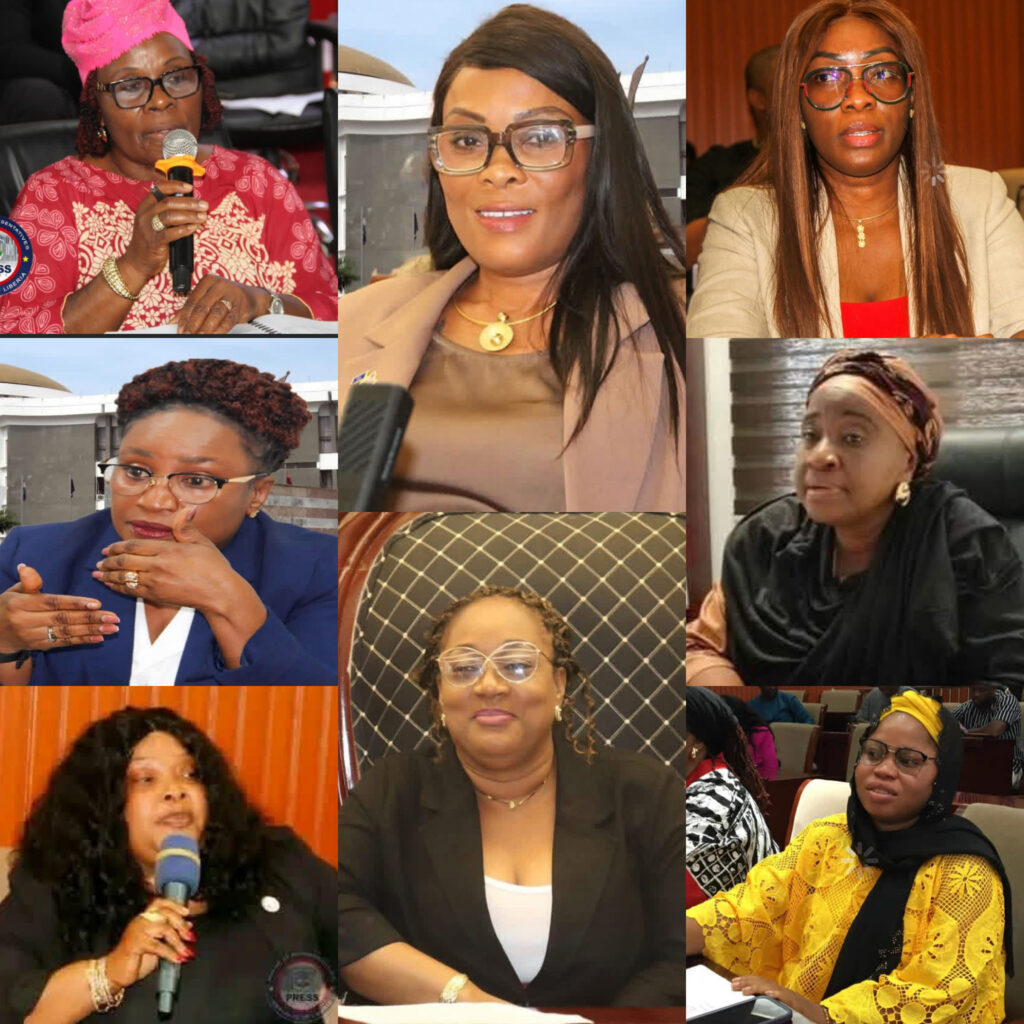
MONROVIA, Liberia – A new monitoring report by the governance think tank Naymote Partners for Democratic Development provides a revealing look at the performance of the legislature’s female lawmakers. Liberia’s bicameral legislature remains a domain of gender imbalance.
With only 11 women occupying 103 seats—just 10.7%—female representation lags significantly behind regional and global averages. Within this challenging landscape, the women of the 55th Legislature have pursued their mandates with varying degrees of impact, and passivity. Also, female lawmakers make up just about nine percent of the House of Representatives membership.
The 2026 Legislative Constituency Monitoring Report tracked 72 Representatives across five key accountability indicators between July 17 and October 9, 2026: the presence of a functional district office, constituency visits, town hall meetings, media/radio engagement, and formal legislative reporting.
An analysis of the eight female lawmakers monitored reveals a stark divide: while several demonstrated exemplary, well-rounded engagement with their constituents, others showed critical gaps, particularly in maintaining physical offices or providing formal legislative updates.
Two female lawmakers achieved a perfect score, receiving a “Yes” across all five accountability indicators. They represent the gold standard of the monitored group. According to the report, Hon. Rugie Yatu Barry (Montserrado District 1) demonstrated complete engagement, maintaining a functional district office, conducting constituency visits, holding town hall meetings, engaging with media, and submitting formal legislative reports.
Hon. Prescilla A. Cooper (Montserrado District 5) mirrored Barry’s success, hitting all five benchmarks and proving that high visibility can be paired with formal documentation.
Several female lawmakers were highly visible on the ground and accessible to their constituents but fell short on delivering formal legislative documentation.
The report says Hon. Juli Fatorma Wiah (Lofa District 2) had a strong showing, recording “Yes” for a functional office, constituency visits, town hall meetings, and media engagement. However, she did not submit a formal legislative report during the monitoring period. Similar to Wiah, Hon. Ellen Attoh-Wreh (Margibi District 3) was highly active, securing “Yes” for an office, visits, town halls, and reports. Her only “No” was in media and radio engagement.
The Partially Accountable
Some lawmakers showed strong physical engagement but struggled with the institutional aspects of representation, such as maintaining an accessible office. Hon. Marie G. Johnson (Grand Gedeh District 2) successfully conducted constituency visits, held townhall meetings, and submitted formal reports. However, the monitors recorded “No” for the presence of a functional district office and “No” for media/radio engagement.
Also, Hon. Moima Briggs-Mensah (Bong District 6) was highly visible, recording “Yes” for visits, town halls, and media engagement. Yet, she did not have a functional district office recorded, nor did she provide a formal legislative report. Hon. Gbessie Sonii-Feika (Grand Cape Mount District 3) maintained a functional district office and engaged in constituency visits and media appearances.
However, she recorded “No” for town hall meetings and “No” for formal legislative reports. The report highlights one female lawmaker who failed to record any of the monitored activities during the 12 weeks.
Hon. Bintu Massalay (Grand Cape Mount District 1) received a “No” across all five indicators—lacking a recorded functional office, constituency visits, townhall meetings, media engagement, and formal reports.
Overall, the report notes that across all 72 lawmakers (male and female), physical engagement was strong (with constituency visits at 91.7%), but institutional accessibility and formal accountability were weaker. Only 62.5% of all lawmakers reported a functional district office, and exactly half (50.0%) failed to provide a formal legislative report.
For the women highlighted in the report, the data suggest that while many are highly effective at maintaining a physical presence and dialoguing with their communities, bridging the gap to formal, documented accountability remains a critical next step.
Male Lawmakers and the Broader Accountability Gap
Based on the 2026 Legislative Constituency Monitoring Report, the performance of the 64 monitored male lawmakers reflects a broader national trend of high physical visibility coupled with significant gaps in formal accountability. Overall, while male lawmakers largely drove the high national rates for physical engagement—with constituency visits recorded at 91.7% and town hall meetings at 77.8% across the entire legislature—many of them failed to provide documented evidence of their work or maintain accessible offices.
Exactly 50.0% of the entire monitored group failed to submit a formal legislative report.
The report highlights a commendable group of 23 male lawmakers who achieved a perfect score, receiving a “Yes” across all five accountability indicators. These top-performing Representatives demonstrated that high community visibility can be successfully paired with institutional accessibility and documentation.
They include Hon. Sam P. Jallah (Bomi District 3), Hon. Robert Flomo Womba (Bong District 4), Hon. Eugene J. M. Kollie (Bong District 5), and Hon. Thomas A. Goshua (Grand Bassa District 5). Others who scored a perfect 5/5 are Hon. Jeremiah G. Sokan (Grand Gedeh District 1), Hon. Jacob C. Debee II (Grand Gedeh District 3), Hon. Thomas P. Fallah (Lofa District 1), and Hon. Ivar K. Jones (Margibi District 2).
The perfect scorers also include Hon. Emmanuel O. Yarh (Margibi District 4), Hon. Clarence G. Gahr (Margibi District 5), Hon. P. Mike Jurry (Maryland District 1), and Hon. Prince A. Toles (Montserrado District 8). They are joined by Hon. Frank Saah Foko Jr. (Montserrado District 9), Hon. Richard N. Koon (Montserrado District 11), Hon. Jerry K. Yogboh, Sr. (Montserrado District 12), and Hon. Edward P. Flomo (Montserrado District 13). Rounding out the top performers are Hon. Bernard Blue Benson (Montserrado District 17), Hon. Ernest M. Manseah (Nimba District 4), Hon. Musa H. Bility (Nimba District 7), and Hon. Taa Z. Womgbe (Nimba District 9). Finally, Hon. Isaac B. Choloplay Wuo (River Gee District 2), Hon. Johnson S. N. Williams Sr. (River Gee District 3), and Hon. Steve Tequah (Rivercess District 2) also recorded perfect scores.
However, the vast majority of male lawmakers fell into a middle category where they were highly visible in their districts but failed to provide formal legislative reports or maintain accessible district offices. For example, lawmakers such as Hon. J. Marvin Cole (Bong District 3), Hon. Matthew Joe (Grand Bassa District 3), and Hon. Anthony F. Williams (Maryland District 2) recorded “Yes” for constituency visits and town hall meetings but received a “No” across the board for district offices, media engagement, and formal reports. Similarly, Hon. Prince K. Koinah (Bong District 1), Hon. James M. Kolleh (Bong District 2), and Hon. Alexander Poure (River Gee District 1) conducted visits and town halls but failed to provide a functional office or a formal legislative update.
A significant number of male lawmakers entirely neglected media and radio engagement during the monitoring period. Despite visiting their districts, these Representatives failed to use broadcast platforms to communicate legislative updates or address public concerns. Lawmakers who recorded a “No” for media engagement include Hon. Clarence T. Banks (Grand Bassa District 2), Hon. Matthew Joe (Grand Bassa District 3), and Hon. Nathaniel N. Bahway (Grand Kru District 1). Others in this group are Hon. Roland O. Cooper (Margibi District 1) and Hon. Alex Job Grant (Rivercess District 1).
At the lowest end of the spectrum, two male lawmakers recorded a “No” for every single monitored activity during the 12-week break, indicating a complete lack of formal, documented engagement with their constituents. These lowest-performing lawmakers are Hon. Nathaniel N. Bahway (Grand Kru District 1) and Hon. Roland O. Cooper (Margibi District 1).
Ultimately, the data for the male lawmakers underscores Naymote’s central finding that while Liberian Representatives are highly active in physical, on-the-ground engagement, the institutional mechanisms that make representation traceable and accountable are severely lacking. As the report notes, “The principal opportunity is to strengthen the institutional practices that make engagement traceable: continuing access, records of discussions, public reports, and updates on action taken. Greater visibility alone does not demonstrate responsiveness or results.”
The most significant failure across the entire legislature was in formal reporting. Exactly half of the monitored lawmakers (50.0%) failed to provide any formal legislative report or update to their constituents during the 12-week break.
“The principal opportunity is to strengthen the institutional practices that make engagement traceable,” Naymote noted in the report’s executive summary. “Greater visibility alone does not demonstrate responsiveness or results.”
Naymote’s monitors noted that while visits and town halls are frequent, they often lack structure. Many events were centered on project dedications, donations, or political networking, offering limited opportunities for substantive policy dialogue or public scrutiny. Additionally, some lawmakers lacked organized schedules, making it difficult for citizens to plan participation.