


Joel Maybury, former U.S. Embassy’s Chief of Mission
At the time of Liberia’s independence on July 26, 1847, the new republic’s population celebrated by singing the national anthem “All Hail, Liberia, Hail!”The lyrics were written by Daniel Bashiel Warner, a 32-year-old native of Baltimore, Maryland, who later served as Liberia’s third president.
What is not well known is that from 1847 to 1860, the anthem’s melody was different than the one Liberians sing today. Enter Cleveland Olmstead Luca. He composed a melody that the republic adopted in 1860 – 13 years after independence.
Cleveland was born in New Haven, Connecticut, in 1826, the son of musically talented parents Alexander Luca and Lisette Lewis. Alexander was a shoemaker. His excellent voice and musical training earned him a position as chorister in the Congregational church in New Haven.
The couple had four sons (John W., Alexander C. Jr., Simeon G., and Cleveland O.). In the 1840s, Alexander Sr. organized a quartet including Dinah Lewis, his wife’s sister and a gifted singer, and his first two sons. He taught his sons the shoemaker’s trade, and with the help of Dinah, they were educated in music.
Alexander taught his children to sing in his choir at the church. All members were highly gifted, and the youngest son, “Cleve” as he was then called, was a piano prodigy by the age of 7, and by the age of 10, he had a repertory of masterpieces and the ability to play difficult music by sight, a talent he frequently proved in public performance.
At some point, the Luca Family Singers consisted of Simeon, who sang first tenor; Alexander Jr., second tenor; Cleveland, soprano; and John, bass-baritone. Simeon played first violin; Alexander Jr., second violin; John, cello or bass; and Cleveland, piano.
Their father was musical director and manager as well as vocalist. They traveled the midwestern and eastern United States performing secular as well as religious music, including anti-slavery hymns and benefit concerts. One of their more popular songs was the anti-slavery hymn “Car of Emancipation.”
Wherever they went they earned a reputation of refinement, intelligence, and superb musicianship. In their May 1853 debut in the Old Tabernacle on Broadway in New York City, as guests of the New York Anti-Slavery Society, they thrilled an audience of 5,000 people. “In witnessing the display of genius by the wonderful pianist, and listening to the sweet strains of classical harmony formed by the tuneful voices and skillfully played instruments of this troupe of colored artists, they found their claims for the race so fully sustained,” wrote medical historian James Monroe Trotter in his book Music and Some Highly Musical People in 1878.
“As the ‘wonderful boy pianist,’ [Cleveland] everywhere created quite a furore (sic). The ladies in the audiences were especially delighted with him; and forgetting often, in their enthusiasm, that he was black, it seemed that they would certainly carry him away.” Trotter said it was “doubtful whether he had an equal in this country.” Trotter described how the “prejudiced or incredulous” would hear the “exquisite charm of the music, as well as to the gentlemanly, graceful manners of the young virtuoso,” and then become “his warm admirer and friend.”
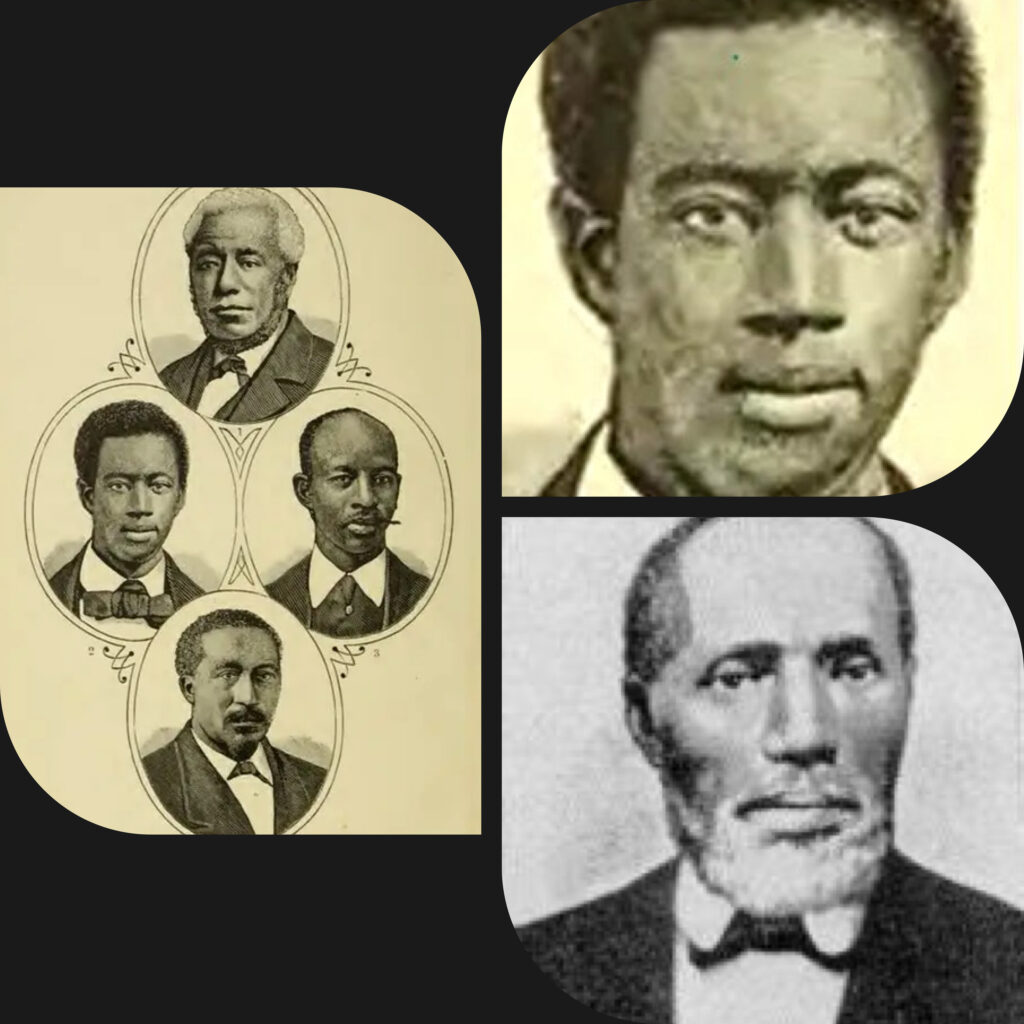
Trotter’s book was the first comprehensive history of American music. He included engraved portrait plates featuring illustrations of the artists, using numbers next to their faces to correspond with their biographical sketches. The illustration of Cleveland, his father, and two brothers is the primary, definitive visual likeness of them known to history. This rare image may be the first time Liberians get to see the face of the man who composed the melody for “All Hail, Liberia, Hail!”
The American press was almost unanimous in praise for their concerts. “The Luca Family, in the quiet and ostentatious display of their musical powers, are doing more to secure position for the colored man than all the theorists and speculators about the rights of man have yet accomplished in America,”
according to a review in the Niagara Courier of Lockport, New York, on September 2, 1857.
In 1859 the Lucas teamed with a white family troupe, the Hutchinsons, abolitionist musicians in their own right.
Both groups drew from an eclectic repertoire, combining comic and temperance songs with classical European arias. Another highly popular abolitionist track, “The Fugitive’s Song,” dramatized the escape of enslaved individuals to freedom.
At the invitation of the president of Liberia in 1860 (presumably Stephen Allen Benson), Cleveland left the group and went to Africa, where he composed Liberia’s national anthem. The troupe temporarily disbanded but its members continued to pursue music individually.
“The musical structure of “All Hail, Liberia, Hail!”features a simple, march-like melody designed for communal singing and ceremonial use. Composed in B-flat major, it employs a straightforward form with repeating phrases that emphasize patriotism and resolve, set at a moderate tempo of quarter note equals 100. The original instrumentation was for piano and voice, allowing for easy adaptation to vocal ensembles or brass bands in performances.
While rooted in Western musical traditions familiar to Liberia’s founders, the melody incorporates subtle rhythmic elements evocative of African influences, reflecting the nation’s dual heritage.” (Source: Grokipedia)
Liberia’s anthem received praise in an article published on Dec. 1, 1918, in The Sunday Sentinel, a newspaper in Milwaukee, Wisconsin. “She has the sonorous and thrilling “All Hail, Liberia, Hail!” The article’s author wrote that the composition is “notable for the rich chords and march movement of the first part and the graceful and flowing melody of the second.
The words and music were written for each other and blend most perfectly.” Those who have heard the anthem with its powerful harmonies “will cheerfully accord it a high rank among the national anthems of the world.”
At some point, Cleveland returned to the United States to resume performing with his family. The Toledo Blade (Ohio) newspaper on February 18, 1872, announced that the “celebrated Luca Concert family” was to give a concert at Wheeler’s Opera House. “This company is composed of Mr. O. Luca, the great pianist; Mr. A. A. (Alexander Jr.) Luca, tenor and violinist; Madame A. A. Luca, contralto and soprano; and Mr. Tino (referred to as John elsewhere) Luca, bassoon.”
Simeon Luca died in 1854 and Jennie Allen, a contralto from New York, joined the group. “The Luca family are not strangers to many of our readers, and those who have recollections of the pleasure afforded by their really excellent music will find cause for rejoicing in this announcement. The Lucas have been received everywhere by large audiences, and as they present an attractive programme here, we may look for a general coming together of music-loving people of Toledo, on Saturday evening next.”
The Toledo Blade went on to cite the Liverpool Courierin England as follows: “The debutante of the evening was Olmstead Luca, pianist, from the west coast of Africa, whose performance was truly marvelous. Directly he struck the keys, you realized the fact that you were in the presence of a genius. He chose two pieces full of the most formidable difficulties, [Antoine] de Kontski’s “La Réveil du Lion” and Chopin’s second Scherzo, both of which were rendered with the utmost precision and elicited enthusiastic applause.” (
Note to readers: Listen to the first minute or so of “Le Réveil du Lion” and you may hear similarities with “All Hail, Liberia, Hail!”). The British press carried detailed accounts, reviews, and political commentary reprinted from American abolitionist papers.
Transatlantic anti-slavery networks shared updates on the family’s artistic triumphs to demonstrate the cultural achievements of African Americans to British audiences.
The Cincinnati Daily Enquirer on March 4, 1872, published an article that praised the Lucas while also commenting on racial attitudes at the time. “The Luca Brothers have high musical talent.”
The newspaper acclaimed Cleveland as the finest pianist in the country. “In Europe he was extensively bespattered with praise. But Olmstead Luca and Olmstead Luca’s brothers and wife are all colored – real Negroes, every one of them, and that is where the failure comes in. Had they pretended to be darkies, not been real ones, their success would have been assured.
Scarce a single (unreadable)-loving Republican attended the concert, not because the music was not good, for it was excellent, but merely because the performance had a visible admixture of African blood in the (unreadable), and that fact settled their hash.”
Shortly after these newspaper reports, the pianist extraordinaire and composer of the Liberian national anthem returned to Liberia and reportedly caught a fever.
Trotter’s book specifically notes that he died on March 27, 1872, at the age of 45. Trotter did not just write a history book; he lived in Cincinnati, taught music in the region, and personally knew the musical networks of the era. Online sources placing his death in 1869 are therefore inaccurate. If he died in
Monrovia, he was probably interred in Palm Grove Cemetery, but there are no records confirming this. Similarly, Warner’s original lyrics and Luca’s original handwritten score are considered lost to time.
Furthermore, it is historically impossible for any audio recordings to exist from the Luca family concerts. Thomas Edison did not invent the phonograph – the very first machine capable of both recording and reproducing sound – until 1877.
About the author: Joel Maybury served as the U.S. Embassy’s Chief of Mission from 2021 to 2023 during which time he began researching facets of Liberia’s history and its unique ties to the United States. His published works include an article about Liberia’s first First Lady Jane Rose Roberts, and he has given public lectures on the years President Joseph Jenkins Roberts lived and worked in Virginia before immigrating to Liberia.
Researched and written by Joel Maybury
July 26, 2026