

By Sampat JMB Kpakimah
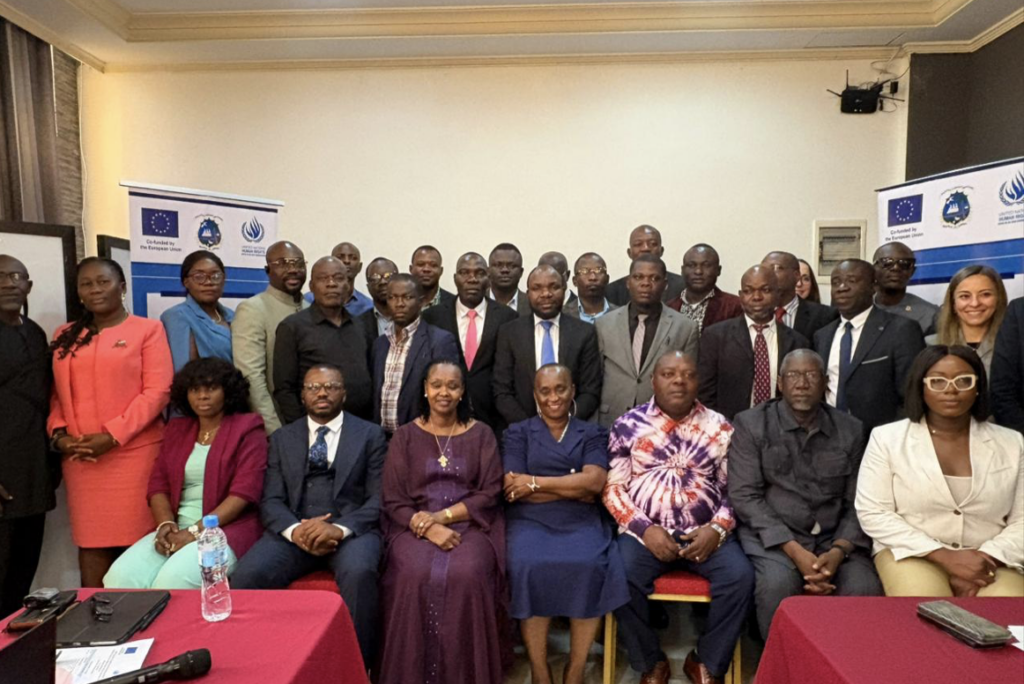
A two-day specialized training on the investigation and prosecution of corruption using a human rights–based approach has commenced at the Royal Hotel, bringing together key justice actors, prosecutors, and anti-corruption institutions.
Representing the Chief of the Economic, Social, and Cultural Rights Section at the Office of the High Commissioner for Human Rights (OHCHR), Mr. Pradeep Wagle described the initiative as timely, noting that Liberia stands at a critical juncture in its transitional justice process.
“It is a profound honor for OHCHR, both in Geneva and Liberia, to support your critical work at this important moment,” Wagle stated. “This is not merely a training exercise, but a response to a global crisis of resource diversion that undermines state legitimacy and human dignity.”
Speaking on Monday, April 21, at the Royal Grand Hotel He emphasized the alarming scale of corruption globally, revealing that between 10 to 25 percent of public funds are lost annually, amounting to at least $3 trillion. This figure, he noted, far exceeds the estimated $2.5 to $4 trillion required annually to achieve the Sustainable Development Goals (SDGs).
Turning to Africa, Wagle highlighted that the continent loses over $140 billion each year to corruption, while requiring approximately $170 billion annually to meet the SDGs. He stressed that these figures translate into “stolen opportunities,” particularly in critical sectors such as health and education.
Citing findings from the United Nations Conference on Trade and Development, Wagle pointed out that countries with high illicit financial flows spend 25 percent less on healthcare and 58 percent less on education, underscoring the direct link between corruption and human rights violations.
He further noted that corruption weakens institutions, erodes the rule of law, and fuels injustice and impunity, ultimately depriving citizens of essential services and protections.
Despite challenges, Wagle acknowledged Liberia’s progress over the past decade, including efforts toward establishing the War and Economic Crimes Court and strengthening the Liberia Anti-Corruption Commission, which he described as a positive step toward accountability and justice.
The training also introduced participants to key principles of a human rights–based approach, including participation, accountability, non-discrimination, transparency, and victim-centered justice, while emphasizing the roles of rights-holders and duty-bearers in corruption cases.
Providing an overview of the workshop, OHCHR Human Rights Officer Marion Deniaud explained that the training is a collaborative effort involving the Independent National Commission on Human Rights, the Ministry of Justice of Liberia, and other partners.
She described the initiative as a technical training aimed at strengthening investigations and prosecutions of corruption through a human rights lens. Deniaud expressed appreciation to partners, particularly the European Union Delegation, for their continued support.
According to her, the training aligns with Liberia’s broader transitional justice agenda and contributes to efforts toward establishing complementary jurisdictions, including the War and Economic Crimes Court and a proposed National Anti-Corruption Court.
Speaking on behalf of the Minister of Justice, Cllr. Cora Hare Konuwa, Deputy Minister for Administration, acknowledged corruption as a longstanding national challenge, stressing that it requires collective responsibility.
“Corruption is not just about others it involves all of us,” she said, urging prosecutors to consider the real-life impact of corruption on citizens.
Reflecting on her personal experience, Konuwa linked corruption to the country’s prolonged conflict, noting that systemic injustices and public dissatisfaction contributed to the outbreak of war.
She further highlighted challenges within the justice sector, including numerous indictments with limited prosecutions due to inadequate funding and resources affecting institutions such as the police and magisterial courts.
“This is no longer something to laugh about,” she emphasized, reaffirming the Ministry’s commitment to strengthening prosecutions and tackling impunity, which she described as a driver of corruption.
For his part, the European Union Delegation to Liberia Ambassador, Zoltán Szalai, encouraged participants to use the platform to openly share challenges and experiences, noting that corruption remains a complex issue requiring collective solutions.
He added that such engagements are essential to rebuilding public trust and ensuring a justice system that serves all citizens equally.
Institutions represented at the training include OHCHR, the European Union Delegation, the UN Resident Coordinator’s Office, the Liberia National Bar Association, INCHR, the Office for the Establishment of the War and Economic Crimes Court, the Law Reform Commission of Liberia, LACC, the Ministry of Gender, the Ministry of Justice, and the Supreme Court of Liberia.
The training continues through April 22, focusing on strengthening institutional capacity to combat corruption while upholding human rights standards.