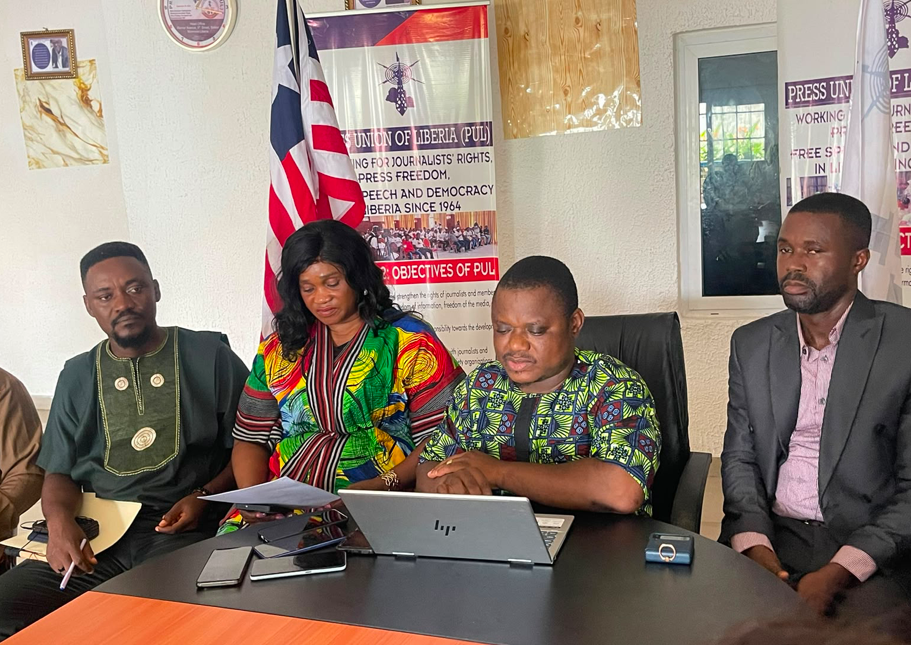
MONROVIA, Liberia – The National Civil Society Consortium for Transitional Justice on Tuesday accused President Joseph Nyuma Boakai’s government of sabotaging Liberia’s international standing by repeatedly failing to establish the War and Economic Crimes Court (WECC) and the National Anti-Corruption Court (NACC), nearly three years after he took office.
The coalition—comprising the Press Union of Liberia, the Center for Transparency and Accountability, the Liberia Council of Churches, and other prominent civil society groups—demanded immediate legislative action, warning that continued delays threaten to expose Liberia as a hypocrite on the world stage just as the nation prepares to assume the presidency of the United Nations Security Council in December 2026.
“Liberia campaigned for and won its Security Council seat on explicit commitments to human rights, justice, accountability, and the Women, Peace and Security agenda,” the Consortium stated. “The absence of decisive government action to establish these courts risks undermining Liberia’s credibility and moral authority internationally.”
The Consortium reminded the government that women, children, and other victims of Liberia’s civil wars have endured more than two decades of impunity. The WECC, it argued, represents not merely a political obligation but a concrete mechanism for delivering the closure and reconciliation that survivors urgently require.
“Women, children, and other victims have waited far too long for justice,” the statement reads. “The lack of a War and Economic Crimes Court perpetuates impunity, denies closure, and weakens reconciliation.”
Civil society leaders further stressed that the WECC is integral to implementing UN Security Council Resolution 1325, which mandates that sustainable peace requires women’s meaningful participation, protection, accountability, and access to justice—not symbolic recognition but tangible remedy.
The Consortium also tied the establishment of the National Anti-Corruption Court directly to the daily struggles of ordinary Liberians. Entrenched corruption, it argued, continues to drain public resources, deepen poverty, and violate citizens’ rights by limiting access to health, education, electricity, and other basic services.
“When established, adequately funded, and fully functional, the Specialized National Anti-Corruption Court will play an indispensable role in ending impunity for corruption, safeguarding public resources, and fostering inclusive and sustainable economic development,” the coalition said.
The Consortium declared both courts “non-negotiable” under Liberia’s obligations to international human rights law, international humanitarian law, and UN rule-of-law frameworks. It demanded that both institutions be designed to meet international standards, including judicial independence, equality before the law, due process, fair-trial guarantees, victim and witness protection, and meaningful victim participation.
Combined, the coalition argued, the two courts would strengthen the rule of law, restore public confidence in state institutions, advance economic and social justice, deter future abuses, reinforce reconciliation, and demonstrate that no one stands above the law.
The Consortium issued a seven-point ultimatum to the government:
1. President Boakai must urgently engage Senate and House leadership to secure timely passage of both court bills and allocate funding in the 2027 national budget.
2. The Legislature must deliberate and pass the bills without further delay, rejecting the tactics of past assemblies that used “constituency engagement” as an excuse for inaction on the Truth and Reconciliation Commission’s 2009 recommendations.
3. The President and Legislature must ensure both courts are adequately resourced, operationally independent, impartial, transparent, victim-centered, and gender-responsive.
4. The Government must align domestic justice and anti-corruption efforts with Liberia’s international commitments, including UNSCR 1325 and subsequent WPS resolutions.
5. The Government must use Liberia’s December 2026 UN Security Council presidency to demonstrate leadership by example—advancing accountability globally while institutionalizing it at home.
6. International partners—including the UN, EU, and U.S. government—must continue supporting Liberia’s accountability drive and press for adequate financing and operationalization of the courts.
7. The Office for the Establishment of WECC must strengthen collaboration with the Presidency, Executive, Legislature, Judiciary, and other stakeholders to achieve this milestone.
The Consortium reaffirmed its readiness to work with national institutions and international partners to ensure both courts are timely established and sustained.
“Justice delayed is justice denied,” the coalition concluded. “And justice denied is a recipe for human rights violations, impunity, violence, poverty and underdevelopment. The Boakai administration must act now!”