By Sampat JMB Kpakimah
University of Liberia (UL) President Dr. Layli Maparyan says the country’s long-term prosperity will depend on investing in human capital rather than relying solely on its abundant natural resources.
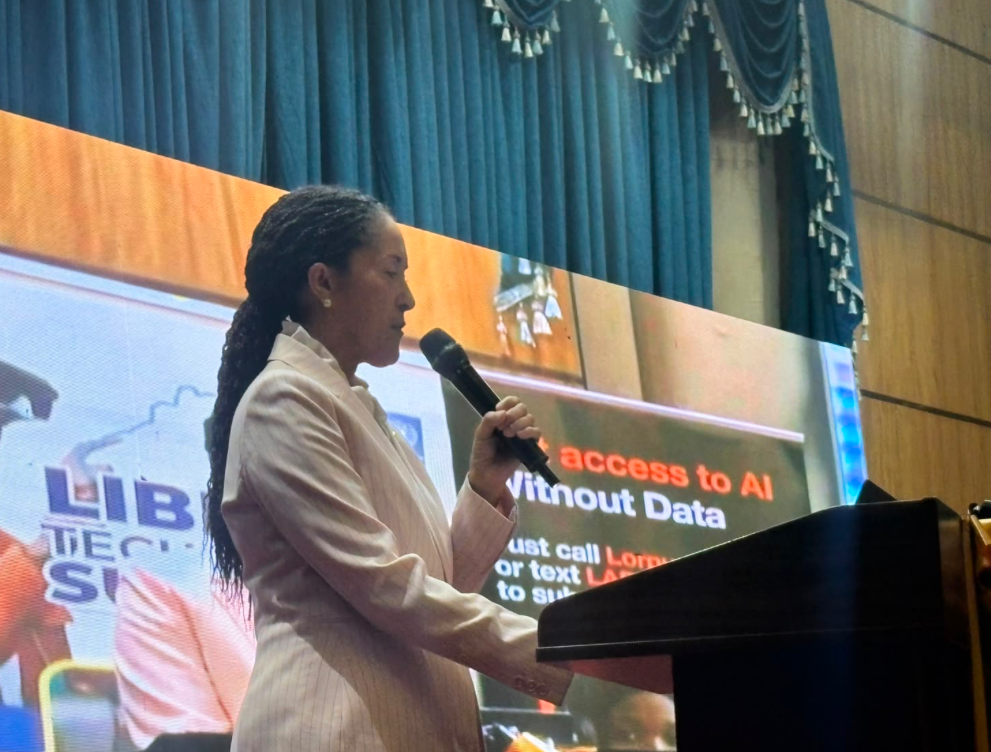
Delivering the keynote address at the Digital Transformation Summit today, July 21, 2026, Dr. Maparyan emphasized that universities must lead Liberia’s transition into the digital age by producing graduates equipped with technological skills, innovation, critical thinking, and entrepreneurship.
Speaking under the theme, “Academia as the Engine of Liberia’s Digital Future: Building the Next Generation of Innovators,” Dr. Maparyan said the University of Liberia is prepared to serve as the nation’s flagship institution for technology-driven education, research, innovation, and workforce development.
“The future of Liberia will not be built by natural resources alone. It will be built by human ingenuity. It will be powered by knowledge, driven by innovation, and sustained by a workforce equipped with digital skills, critical thinking, creativity, and ethical leadership,” she said.
Dr. Maparyan recounted a recent state visit to Ethiopia, where she accompanied President Joseph Nyuma Boakai Sr., describing the experience as an eye-opener to what strategic investment in digital transformation can achieve.
She noted that Ethiopia has rapidly modernized its economy through its Digital Ethiopia strategy by expanding e-government services, digital payment systems, nationwide digital infrastructure, technology-driven education, and artificial intelligence initiatives.
According to her, Ethiopian universities have become central to the country’s digital revolution by introducing online degree programs, establishing advanced multimedia production studios, creating technology business incubators, and launching one of Africa’s leading artificial intelligence institutions.
She disclosed that Ethiopian officials expressed interest in partnering with the University of Liberia and other Liberian higher education institutions to strengthen collaboration in artificial intelligence, technology education, and research.
Drawing lessons from Ethiopia’s experience, Dr. Maparyan said Liberia has an opportunity to transform its own higher education system into a platform for national innovation and economic growth.
She highlighted ongoing efforts at the University of Liberia, including the strengthening of its Computer and Information Sciences programs, the planned launch of a Master’s degree in Artificial Intelligence and Cybersecurity with support from the United Nations Development Programme (UNDP), and collaboration through the Liberia UniPod initiative.
Dr. Maparyan observed that between 75 and 80 percent of Liberia’s population consists of digital natives, stressing that many young Liberians already possess technological abilities that can be further developed through quality education and mentorship.
“Our responsibility is to provide them with an educational environment where they can thrive, mentorship that respects their intelligence and aspirations, and opportunities to transform their ideas into impactful innovations,” she stated.
She urged universities across Liberia to modernize their curricula by integrating digital technologies into disciplines such as agriculture, medicine, engineering, environmental science, business, education, public administration, and the arts.
The UL President also called for stronger collaboration between higher education institutions and industry through internship opportunities, faculty exchanges, collaborative curriculum development, innovation laboratories, technology hubs, startup incubation programs, and increased investment in student-led entrepreneurship.
Using Ethiopia’s agriculture sector as an example, Dr. Maparyan described how university graduates are trained in digitally enabled commercial farming before receiving farmland to establish their own agribusinesses. She suggested that similar initiatives could be explored using farmland at the University of Liberia’s Fendall Campus.
She further emphasized that preparing students for employment now requires direct collaboration between universities and employers to ensure academic programs reflect labor market needs and technological advancements.
Dr. Maparyan concluded by inviting government, the private sector, development partners, financial institutions, and global technology companies to partner with the University of Liberia in building a digitally empowered workforce capable of driving Liberia’s future development.
She said the Digital Transformation Summit should serve as a catalyst for sustained collaboration among stakeholders committed to positioning Liberia as a competitive player in the global digital economy.
“Our young people deserve a digital Liberia, and Liberia’s future demands it,” Dr. Maparyan concluded.
This version is written in a standard newspaper format with a compelling lead, strong attribution, logical flow, and a balanced use of direct quotations suitable for publication.