BY SHALLON S. GONLOR | shallonsgonlor@gmail.com
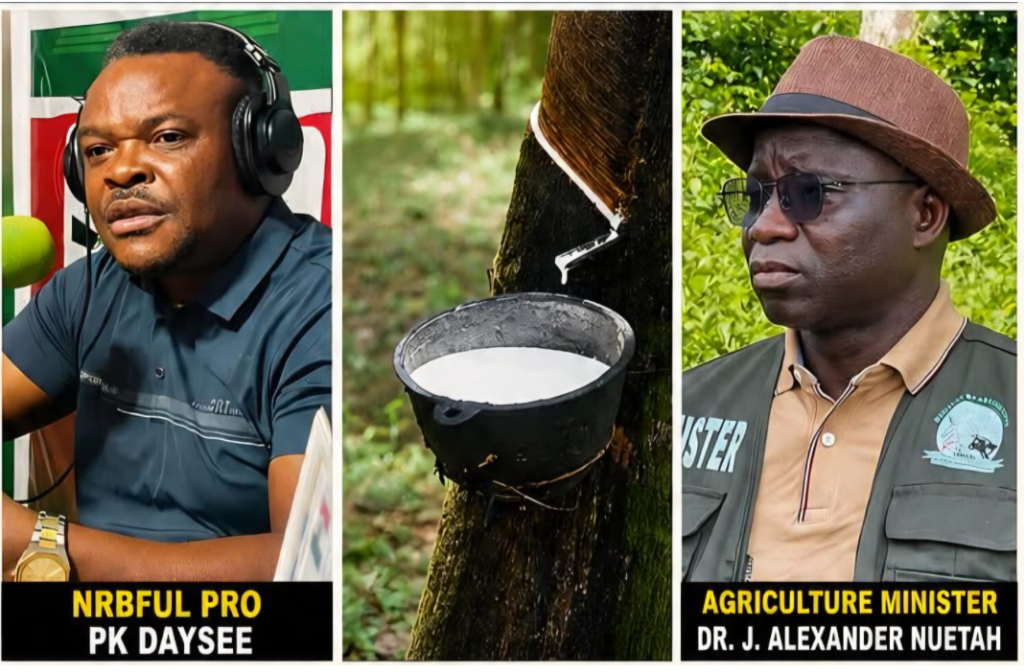
NIMBA COUNTY, Liberia — Frustration and uncertainty are mounting across Liberia’s rubber sector as members of the National Rubber Brokers and Farmers Union of Liberia (NRBFUL) have threatened to stage a peaceful nationwide protest to demand the immediate resignation of Agriculture Minister Dr. J. Alexander Nuetah, accusing the government of abandoning the interests of thousands of rubber farmers and brokers.
The planned demonstration follows growing opposition to Executive Order No. 166, which prohibits the exportation of unprocessed rubber. While the government says the policy is intended to strengthen domestic manufacturing and protect local industries, many brokers and smallholder farmers argue that it has severely disrupted their livelihoods.
Speaking during a press briefing in Ganta City, Nimba County, on July 20, 2026, NRBFUL Public Relations Officer P.K. Daysee expressed disappointment with the administration of President Joseph Nyuma Boakai, saying rubber farmers who supported the government now feel abandoned.
“We voted for this government to rescue us. If they don’t want to rescue us, let them leave us,” Daysee declared.
According to Daysee, rubber farmers and brokers continue to face mounting economic hardships while the Ministry of Agriculture has failed to adequately engage stakeholders or provide practical solutions to the challenges confronting the sector.
Dr. Nuetah, an Agricultural Economist with more than two decades of professional experience, assumed office as Liberia’s Minister of Agriculture in February 2024 following his appointment by President Boakai. Since taking office, he has championed policies aimed at increasing agricultural production, promoting value addition, and strengthening Liberia’s agro-industrial sector.
However, his administration is now facing increasing criticism from segments of the country’s rubber industry, which argue that recent government policies have adversely affected their businesses.
At the center of the dispute is Executive Order No. 166, signed by President Boakai on June 26, 2026, banning the export of unprocessed rubber. The Executive Order forms part of the government’s broader strategy to revive Liberia’s rubber processing industry by ensuring that more raw rubber is processed domestically instead of being exported in its raw form.
Government officials argue that the policy will protect local industries, preserve existing jobs, create new employment opportunities, increase government revenue, and transition Liberia from exporting raw materials to producing value-added products.
The Ministry of Agriculture has also introduced a national rubber pricing mechanism benchmarked against international market prices to ensure farmers receive fair compensation while eliminating exploitative pricing practices. The pricing policy followed the establishment of the Liberia National Rubber Pricing Committee, created by President Boakai in 2025 after years of complaints from farmers over inconsistent and unfair market prices.
Farmers Reject Policy
Despite those assurances, the National Rubber Brokers and Farmers Union says Executive Order No. 166 has negatively affected thousands of brokers and smallholder farmers who depend on exporting raw rubber for their livelihoods.
Union leaders contend that the restrictions have reduced market opportunities, limited competition among buyers, and created serious financial hardships for those engaged in the rubber trade.
Executive Committee member Anthony Lee disclosed that the union will determine its next course of action during a scheduled meeting on July 22, after which members intend to organize a peaceful nationwide protest demanding Minister Nuetah’s resignation.
“We will have a peaceful protest for the Agriculture Minister to leave after our meeting on the 22nd,” Lee said.
The planned demonstration signals a significant escalation in the union’s campaign against the Ministry of Agriculture, with members insisting that immediate government intervention is needed to address what they describe as worsening economic conditions affecting rubber-producing communities across Liberia.
Government Defends Executive Order
The government’s position is based largely on concerns over a growing shortage of raw rubber available to domestic processing factories.
During a legislative hearing on July 15, the Ministry of Agriculture disclosed that Liberia’s six rubber processing companies require approximately 36,600 metric tons of raw rubber each month to sustain operations but currently receive only about 14,000 metric tons, leaving a monthly deficit of 22,600 metric tons.
According to figures presented to lawmakers, Firestone Liberia requires 7,500 metric tons monthly but receives about 5,800 metric tons. Lee Group needs 6,000 metric tons but receives only 600 metric tons, while Nimba Rubber Incorporated requires 9,000 metric tons but currently receives just 1,340 metric tons. Cavalla Rubber Corporation requires 5,000 metric tons each month but receives only 640 metric tons, and Jeety Rubber LLC, which requires approximately 14,000 metric tons monthly, also faces significant supply shortages.
The Ministry has attributed much of the deficit to the continued export of roughly 22,000 metric tons of unprocessed rubber each month, arguing that the practice deprives local factories of the raw materials needed for production.
Officials further maintain that unrestricted exports weaken domestic manufacturing, reduce employment opportunities, and limit government tax revenues.
Appearing before the House Specialized Committee on the Export of Unprocessed Rubber, chaired by Representative Nyan G. Flomo, businessman and Jeety Rubber owner Upjit Sachdeva, commonly known as Jeety, warned that Liberia’s rubber processing industry could face serious consequences if raw rubber exports continue.
“We were already running under capacity. We are going below capacity because rubber is being exported unprocessed,” Sachdeva told lawmakers.
He challenged critics of the Executive Order by pledging that, if sufficient raw rubber is made available, Jeety Rubber would manufacture Liberia’s first tire before December 31, 2028.
“I challenge everybody—give me rubber, and I will give you your first tire in the Republic of Liberia before December 31, 2028. If we are exporting our raw material, then we are exporting our jobs,” he said.
Sachdeva further revealed that Jeety Rubber currently faces a daily shortage of nearly 200 metric tons of raw rubber, warning that the deficit could increase to between 350 and 400 metric tons in the coming months.
He disclosed that while the company requires a three-month inventory of raw materials to maintain uninterrupted operations, it presently has only 30 to 35 days of stock available.
Without immediate intervention, he cautioned, the factory could eventually suspend operations, placing nearly 600 employees at risk of losing their jobs.
As of the publication of this report, the Ministry of Agriculture had not publicly responded to the latest protest threat issued by the National Rubber Brokers and Farmers Union.
Meanwhile, Executive Order No. 166 remains in force as lawmakers continue consultations with stakeholders over its long-term economic implications and the future of Liberia’s rubber industry.