

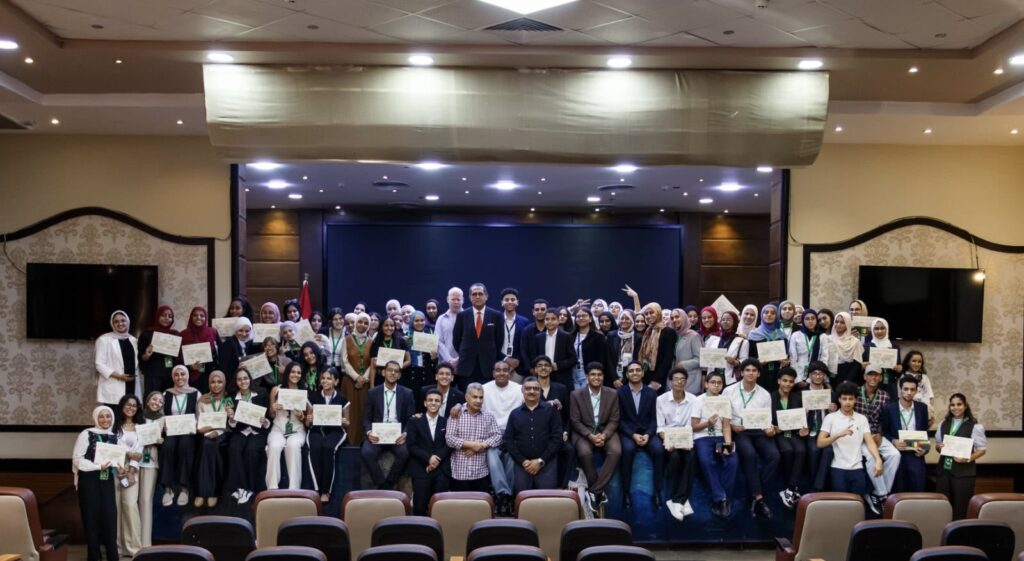
CAIRO — Egypt’s Global Solidarity Network has brought its 2026 African Union Simulation Model to a close, capping off a month-long training programme that drew 120 young men and women from across the country’s Schools of Excellence in Science and Technology (STEM).
Held throughout August, the initiative gave students a hands-on introduction to how the African Union actually works — its institutions, its decision-making processes, and the cooperation frameworks that bind member states together. The goal, organisers say, was to move beyond textbook knowledge and let participants simulate the real work of continental diplomacy.
Three Tracks, One Continent
The programme was structured around three thematic pillars: Peace and Security, Intra-African Trade, and African Civil Society — each led by specialists drawn from academia, government, and international institutions.
The opening lecture came from Ambassador Amr El Gawaly, who heads the African Union Commission’s Directorate of African Diaspora Organizations and Civil Society in Addis Ababa. He walked students through the economic weight of the African diaspora in driving development on the continent.
On peace and security, sessions tackled conflict dynamics, peacebuilding, and governance reform. Hassnaa Tammam, the AU’s Youth Ambassador for Peace in North Africa, unpacked the concepts of conflict and violence, while Hager Azzouz broke down the African Governance Architecture (AGA) and the African Peace and Security Architecture (APSA) — the twin frameworks meant to keep the continent stable. Dr. Heba Assem of the AU Commission posed a pointed question to the room: how can young people help deliver on Agenda 2063’s promise to “silence the guns”? Political researcher Ibrahim Tantawy rounded out the track.
The economic sessions turned to trade integration and the pressures facing African economies in a shifting global order. Dr. Mohamed Hassan Khodairy examined the African Continental Free Trade Area (AfCFTA), Dr. Samar El Bagoury assessed how resilient African economies really are in the face of geopolitical shocks, and Dr. Raed Salama traced how global political developments are rippling through the continent’s supply chains.
Civil Society Takes Centre Stage
A dedicated module explored the Economic, Social and Cultural Council of the African Union (ECOSOCC), the body tasked with bringing civil society and youth voices into AU decision-making. Ambassador Mohamed Haroun, ECOSOCC’s Vice President, spoke on building conscious African leadership, while researcher Farouk Deif examined the council’s role in shaping the continent’s future. Dr. Abdel Latif Gouda closed out the segment with a session on how NGOs can seek accreditation and formally plug into AU structures.
A Platform for the Next Generation
Hassan Ghazaly, the anthropologist and researcher who founded the Global Solidarity Network, said the programme is about more than information — it’s about building a generation of Africans who see themselves as stakeholders in the continent’s future, not passers-by.
“The model represents an integrated educational platform that provides youth with the opportunity to understand decision-making mechanisms within the African Union through a simulation experience combining academic knowledge and practical application,” Ghazaly said, adding that the aim is to promote an African perspective grounded in the continent’s own priorities and realities, rather than narratives imposed from outside.
He said the training was designed to sharpen participants’ skills in dialogue, negotiation, analysis and position-building — tools he believes are essential if young Africans are to become genuine partners in peace, development and integration efforts going forward.
Ghazaly praised the team behind the programme, singling out researcher and translator Mervat Sakr, African affairs researcher Abdullah Qazzaz, and Teyam Mohamed, President of the STEM Schools’ student body, for steering the initiative to completion.
A Long-Running Model
First launched in 2012, the African Union Simulation Model has become a fixture of the Global Solidarity Network’s youth programming, pairing classroom learning with simulated diplomacy to build the next generation of African policy voices — negotiators, analysts and decision-makers alike.