

By Vaye Abel Lepolu
NEW YORK — Liberia has called for climate finance to reach local communities protecting the country’s forests, rivers, fisheries and coastlines, warning that climate-related pressures on natural resources could threaten peace and stability where institutions are weak and communities are excluded from decision-making.
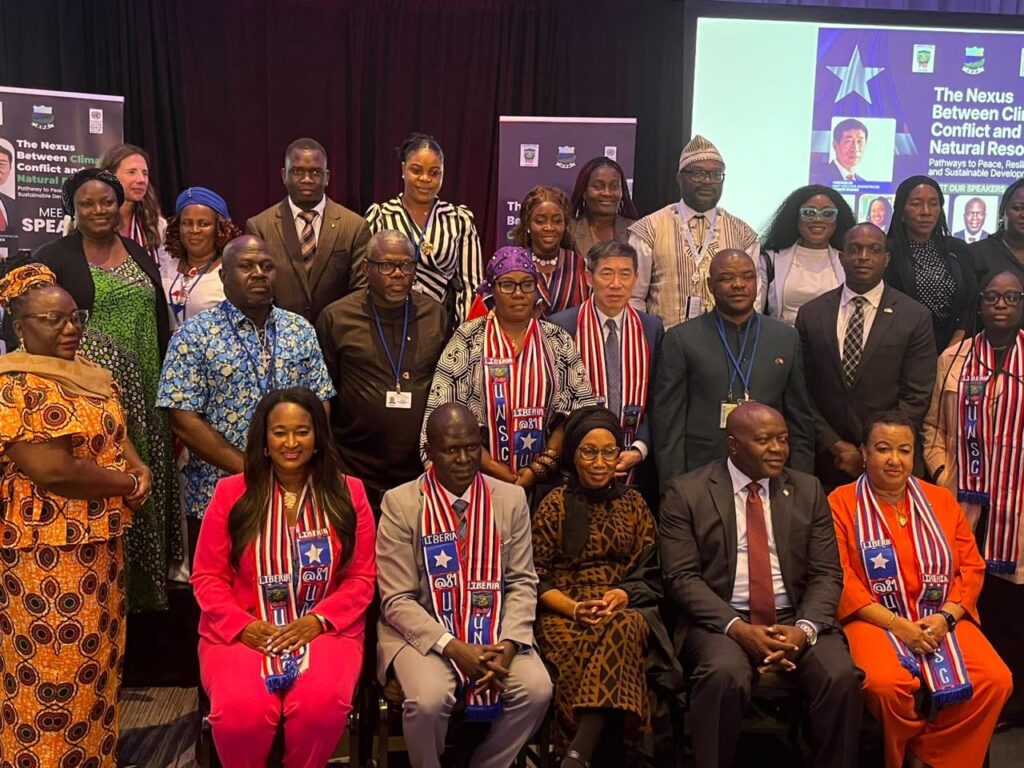
The call was made Wednesday at a high-level side event titled “The Nexus Between Climate, Conflict and Natural Resources: Pathways to Peace, Resilience, and Sustainable Development,”held during the United Nations General Assembly in New York.
The event was convened by Liberia’s Environmental Protection Agency (EPA), in partnership with the United Nations Development Programme (UNDP), under Liberia’s 2026–2027 tenure on the UN Security Council.
Liberian officials, UNDP leaders, African climate negotiators, philanthropic organizations and members of the Liberian diaspora participated in the discussion.
“Climate action cannot be separated from peace building. Natural resource management cannot be separated from justice, transparency, community participation, sustainable livelihoods,” said Dr. Emmanuel K. Urey Yarkpawolo, Executive Director of the EPA
Yarkpawolo said climate change should not be viewed as an automatic cause of conflict, but as a “threat multiplier” capable of worsening poverty, food insecurity, displacement, inequality and competition over scarce resources.
He said Liberia wants climate-related risks to receive serious and balanced attention during its current term on the Security Council.
He also emphasized the importance of ensuring that women, young people and local communities participate in shaping climate policies and benefit from climate investments.
Opening remarks delivered on behalf of Foreign Minister Sara Beysolow Nyanti stressed Liberia’s growing focus on the links between climate security and peacebuilding.
The remarks also echoed Africa’s demand for greater climate justice through improved access to adaptation financing, technology and technical capacity.
“The climate crisis is global, but its consequences are local. Our responsibility is shared, but our capacities are not equal,” the remarks stated.
Delivering the keynote address, Haoliang Xu,UN Under-Secretary-General and Associate Administrator of UNDP, noted that Liberia contributes only 0.03 percent of global emissions, while its third-generation Nationally Determined Contribution targets a 64 percent economy-wide emissions reduction.
Xu said UNDP supported Liberia in developing its National Adaptation Plan and preparing its NDC 3.0.
He also pointed to a growing connection between climate policy and peace and security in national climate plans.
According to Xu, peace and security considerations feature in 41 percent of third-generation NDCs, increasing to 70 percent among NDCs submitted by countries in fragile contexts.
Hon. Jeanine M. Cooper Chief Executive Officer of the Liberia Carbon Markets Authority and Presidential Envoy on Climate Action, said Liberia has begun registering carbon projects and developing regulatory and valuation systems for the sector.
She said the country is seeking to position itself as a source of high-integrity, nature-based climate solutions while ensuring that communities benefit from carbon-market activities.
The emphasis on community benefit-sharing comes as Liberia looks to mobilize financing from its forests and other natural resources while strengthening safeguards around environmental investments.
For Oretha Juah-Bestman-Yates, Assistant Minister for Human Resources at the Ministry of State for Presidential Affairs, the climate crisis is personal.
She recounted losing her childhood coastal community to erosion and urged international leaders to provide predictable and accessible financing for communities facing climate-related displacement.
She called for greater investment in coastal protection, flood-control measures, early-warning systems and safe relocation for families whose communities are increasingly threatened by erosion and other climate impacts.
The panel, moderated by Francine Pickup,UNDP Deputy Assistant Administrator and Deputy Director of the Bureau for Policy and Programme Support, brought together African climate and policy leaders.
Participants included Ambassador Dr. Ali Daud Mohamed, Kenya’s Special Envoy for Climate Change; Nana Dr. Antwi-Boasiako Amoah, Chair of the African Group of Negotiators and Director for Adaptation, Climate Resilience and Risk Management at Ghana’s Environmental Protection Authority; and Colorado State Representative Naquetta Ricks, President and Co-Founder of the African Chamber of Commerce Colorado.
Daniel Kandy,Climate and Environmental Policy Specialist at the Minderoo Foundation, also addressed financing for forests and biodiversity as tools for strengthening climate resilience and peace.
Speakers broadly called for climate finance to reach subnational governments and community institutions, alongside stronger governance of natural resources.
They also urged governments and development partners to treat resilient infrastructure not simply as a cost, but as a long-term investment in stability, livelihoods and sustainable development.
Liberia’s Environmental Protection Agency is the country’s principal environmental regulatory institution. Established in 2002, the agency is responsible for environmental protection, pollution control, biodiversity conservation, climate resilience and sustainable natural resource management.
The EPA also leads Liberia’s implementation of commitments under major multilateral environmental agreements, including the UN Framework Convention on Climate Change, the Paris Agreement, the Convention on Biological Diversity and the UN Convention to Combat Desertification.
The New York discussions underscored Liberia’s argument that addressing climate vulnerability is not only an environmental challenge but also a question of peace, justice, economic opportunity and community security.