By Vaye Abel Lepolu
MONROVIA— The Environmental Protection Agency (EPA) has launched Liberia’s updated Climate Change Gender Action Plan (CCGAP), its first Gender Policy, and the Gender and Climate Change Baseline Assessment Report, with calls for stronger women’s participation, adequate financing, and inclusive climate governance.
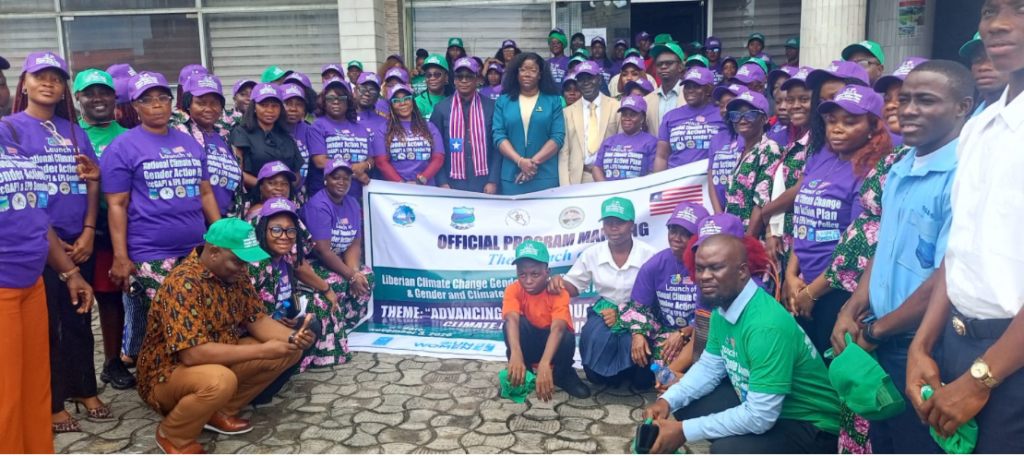
The launch, held under the theme, “Advancing Gender Equality for Inclusive Climate Resilience in Liberia,”is intended to strengthen gender equality in environmental protection and ensure that women, young people, and persons with disabilities benefit from climate-related programs.
The three documents are expected to provide a framework for integrating gender considerations into institutional policies, climate investments, and national environmental programs.
Speaking at the ceremony, EPA Executive Director Dr. Emmanuel Urey Yarkpawolo said the initiative represents a significant milestone in Liberia’s commitment to gender equality and climate resilience.
Dr. Yarkpawolo noted that climate change affects people differently, particularly women farmers, young people, and persons with disabilities, who often face barriers to accessing resources and participating in decision-making.
He said the EPA Gender Policy was developed following institutional assessments, consultations with staff and stakeholders, and a review of existing policies.
According to him, the policy addresses recruitment, promotion, training, leadership, workplace culture, discrimination, sexual harassment, and institutional accountability.
The EPA Executive Director explained that the updated Climate Change Gender Action Plan aligns with Liberia’s national climate commitments under the Nationally Determined Contribution (NDC 3.0).
The plan focuses on eight priority sectors: agriculture and food security, coasts and fisheries, forestry, health, water and sanitation, waste management, energy, and transportation.
Dr. Yarkpawolo stressed that climate resilience cannot be achieved without addressing the barriers that prevent women from accessing land, finance, information, and leadership opportunities.
He cited women farmers as an example, noting that while they possess valuable knowledge of changing rainfall patterns, many lack the resources to respond effectively to climate challenges.
He also disclosed that the EPA has elevated its gender function to senior management level and is strengthening the capacity of women environmental inspectors.
The EPA boss called on all departments to take ownership of the implementation of the policies, emphasizing that gender equality must be reflected in institutional decisions, budgets, and daily operations.
Meanwhile, the Gender and Climate Change Baseline Assessment Report has highlighted the limited representation of women in Liberia’s national climate governance structures.
According to the assessment, women accounted for only 21 percent of membership in the National Climate Change Steering Committee, raising concerns over their participation in decisions affecting the country’s climate future.
Deputy Minister for Research, Policy and Planning at the Ministry of Gender, Children and Social Protection, Curtis V. Dorley, said the launch of the three documents represents an important step toward making gender equality and climate resilience central to Liberia’s development agenda.
Dorley emphasized that climate change is already affecting the daily lives of Liberians through unpredictable rainfall, coastal flooding, erosion, declining fishing livelihoods, and challenges in accessing safe water.
He called for increased gender-responsive climate financing, measurable representation of women in climate governance, and stronger disability inclusion.
The Deputy Minister also urged environmental programs to recognize women’s unpaid care responsibilities and address gender-based violence risks associated with climate-related displacement and economic hardship.
He stressed the importance of collecting reliable data disaggregated by sex, age, disability, and location to measure the actual impact of climate interventions.
“The success of a policy is not measured by the number of pages it contains or the ceremony at which it is launched. Its success is measured by the positive changes it produces in people’s lives,” Dorley emphasized.
He further called for women to be recognized not only as beneficiaries of climate programs but also as entrepreneurs, researchers, innovators, and leaders in Liberia’s emerging green economy.
Cllr. Yah Vallah Parwon, Director of medica Liberia, welcomed the initiative and called for stronger integration of sexual and gender-based violence prevention and response mechanisms into environmental and climate programs.
She said environmental pressures can deepen existing inequalities and increase protection risks for women and girls, particularly those in rural communities and those living with disabilities.
Parwon urged the EPA and its partners to establish accessible complaint mechanisms, safeguarding measures, and referral pathways for survivors of violence.
She emphasized that the success of the gender and climate policies should be reflected in women’s safety, meaningful participation in decision-making, and fair access to opportunities.
The Ministry of State for Presidential Affairs has also reaffirmed its support for the EPA’s gender and climate initiative, describing the launch as a major step toward inclusive climate action and environmental sustainability.
In a statement delivered by Dowahlyn Bestman, Senior Technical Assistant in the Office of the Deputy Minister, the Ministry commended the EPA and its development partners for developing the three instruments.
The Ministry endorsed the Climate Change Gender Action Plan as a critical tool for mainstreaming gender into Liberia’s national climate policies, strategies, and programs.
It further reaffirmed the Office of the President’s commitment to ensuring that gender-responsive climate action remains central to the ARREST Agenda for Inclusive Development, the National Climate Change Policy, the Paris Agreement, and the Sustainable Development Goals.
The Ministry pledged continued collaboration with the EPA and other government institutions to ensure effective implementation, coordination, and monitoring.
The launch brought together government officials, development partners, members of the diplomatic community, civil society organizations, women and youth groups, and other stakeholders.
Stakeholders maintained that the success of the newly launched instruments will depend on adequate funding, institutional commitment, measurable targets, and sustained accountability to ensure that women and vulnerable groups are not left behind in Liberia’s climate resilience efforts.