

-Pres. Boakai Tells World Leaders at 81st Session of the United Nations General Assembly
By Jerromie S. Walters
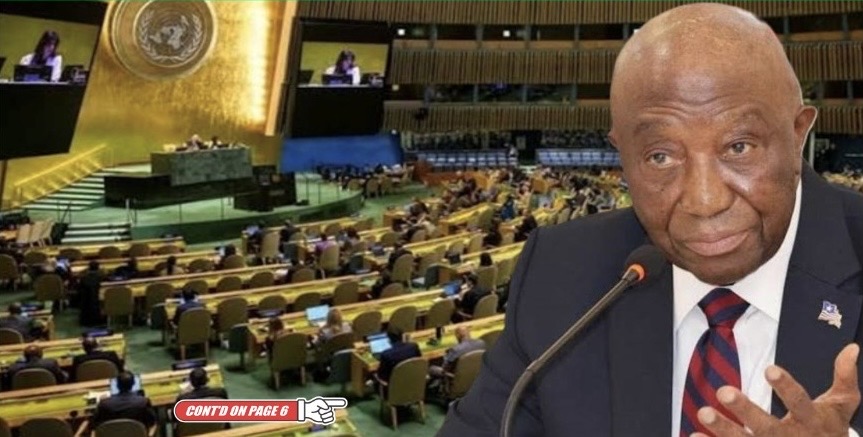
UNITED NATIONS, New York — President Joseph Nyuma Boakai, Sr. declared before the 81st United Nations General Assembly on Thursday that gender equality “remains essential,” asserting that women’s leadership produces longer-lasting peace, faster economic growth, and more accountable governance.
“Gender equality remains essential. When women lead, peace agreements last longer, economies grow faster, and governance becomes more accountable,” Boakai told heads of state, diplomats, and global policymakers gathered at UN Headquarters. “Liberia remains committed to full political, economic, and social equality for women and girls.”
Boakai’s address came just days after his government launched Liberia’s Third National Action Plan on Women, Peace and Security, known as NAP III, at a high-level UN side event in New York. The plan, which runs from 2026 to 2031, formally integrates women into conflict prevention, justice, and security institutions.
It sets a mandatory target of 15 percent female representation in the Armed Forces of Liberia by 2028. The current figure stands at approximately 7.5 percent, according to UN Women data cited at the launch. Boakai’s history with Liberia’s women’s peace movement lent the moment particular weight.
Nobel laureate Leymah Gbowee, speaking at the launch event, recalled that a then-private citizen Boakai had contributed $300 from his own pocket to the women’s peace campaign in 2003. “He told us to keep going and keep doing, for the legacy of peace in Liberia,” Gbowee said, turning to the President. “That person was you.”
Finance Minister Augustine Ngafuan disclosed at the NAP III launch that the Ministry of Gender, Children and Social Protection has seen its budget increase by nearly 80 percent compared to 2023 levels. Boakai also used the UNGA platform to pledge an $8.3 billion investment plan over five years, targeting gender equality, education, healthcare, and youth empowerment.
The Liberia Women Empowerment Project, a $44.6 million World Bank-funded initiative led by the Ministry of Gender, is already delivering results. The project targets 36,000 women entrepreneurs across six counties, with a goal of impacting 260,000 lives.
As of July 2026, 183 women-led enterprises had been approved for funding in a single review cycle, with an expected reach of over 2,000 beneficiaries—approximately 83 percent of them women. The administration’s commitment to women’s leadership has been reflected in the composition of its own Cabinet—though not without controversy.
Following the nomination of Cllr. Betty Lamin-Blamo as Justice Minister in early September 2026, female representation in Liberia’s 19 ministerial positions reached a historic peak of approximately 47 percent, with women leading key ministries including Foreign Affairs, Defense, and Health.
But within days, two women holding strategic portfolios—Geraldine J. George at the Ministry of National Defense and Magdalene E. Dagoseh at the Ministry of Commerce and Industry—were replaced by men in acting capacities, with no immediate announcement of their reassignments. The changes reduced female Cabinet representation to 36.8 percent.
The Feminist Coalition, a Liberian advocacy group, issued a sharp rebuke, warning that “a change in assignment must not become a reduction in influence.” “Women should not have to celebrate gaining a seat at the table today, only to question whether that seat will still exist tomorrow,” the coalition stated, calling on Boakai to clarify the status of the two reassigned ministers.
The episode has reignited debate about the durability of women’s political gains when they depend primarily on presidential discretion rather than institutional rules. The Feminist Coalition pointed to the stark imbalance in the Legislature, where women hold just 11 of 103 seats—approximately 10.7 percent—despite constituting over 50 percent of registered voters in the 2023 elections.
Liberia’s Elections Law, amended in 2014, includes a provision urging political parties to “endeavour to ensure” at least 30 percent representation of each gender in governing bodies and candidate lists. But the provision lacks enforcement mechanisms, and only two of 32 parties met the voluntary benchmark in the most recent elections.
The coalition is now pressing for an enforceable pathway to parity in the revised Elections Law, arguing that progress at the Cabinet level “does not automatically change the rules that determine who is nominated, financed and elected.” Civil society organizations have also raised concerns about the administration’s engagement with grassroots women’s groups.
The Women NGOs Secretariat of Liberia, a coalition of local organizations, has formally criticized the government for what it describes as a lack of recognition of the critical contributions of community-based civil society actors. WONGOSOL has also emerged as a vocal critic of delays in establishing the War and Economic Crimes Court and the National Anti-Corruption Court—institutions the group argues are essential to delivering justice for women who suffered disproportionately during Liberia’s civil conflicts.
“Justice delayed is justice denied,” WONGOSOL warned in a statement, emphasizing that women must remain central to accountability efforts. The group noted that nearly two years after Boakai issued Executive Order No. 131 establishing the office to create the war crimes court, the process remains stalled. The organization has called on Boakai to “remove bottlenecks and fast-track the Court establishment process”.
On the economic front, critics have noted that while flagship micro-grant programs are delivering results for women in the informal sector, national macroeconomic strategies continue to favor formal sectors.
Advocacy groups argue that national addresses often fail to integrate a comprehensive, gender-responsive approach for women in agriculture and the vast informal workforce, where the majority of Liberian women earn their livelihoods. The administration’s efforts to address harmful traditional practices have also encountered obstacles.
A temporary moratorium on certain practices remains in place, but converting it into a permanent, enforceable national law requires legislative approval—a process that advocates acknowledge will be difficult given entrenched traditional systems in rural communities.
The Ministry of Gender has maintained a zero-tolerance policy on gender-based violence, backed by budgeted awareness campaigns. But enforcement remains a challenge.
The gains:
Despite these challenges, the Boakai administration’s gender equality agenda has achieved unusual international visibility for a country of Liberia’s size. The launch of NAP III at the UN General Assembly, the targeting of female military recruitment, and the substantial budget increase for the gender ministry have positioned Liberia as a vocal advocate for women’s leadership on the global stage.
Foreign Minister Sarah Beysolow Nyanti, who has been a prominent voice in Liberia’s Security Council diplomacy, said the Women, Peace and Security agenda was identified as the country’s “number-one priority” during its campaign for a non-permanent seat on the Council. Liberia holds the presidency of the UN Security Council in December 2026.
More on the address:
In his address, Boakai also called for urgent reform of the international financial system, saying developing nations are “being squeezed by unsustainable debt, shrinking fiscal space, and mounting external shocks.”
“At its core, this is a crisis of an international financial system designed for a different era,” he said, calling for concessional financing, debt sustainability, and a fairer voice for developing countries within the World Bank and International Monetary Fund.
The President reaffirmed Liberia’s support for the Common African Position on UN Security Council reform, demanding no fewer than two permanent seats for Africa, with all accompanying rights and responsibilities, including the veto. “Eighty years of patience is enough,” Boakai said. “The time for structural reform is now.”
As the President concluded his address and stepped back from the podium, the implications of his words extended far beyond the chamber’s walls. The $8.3 billion investment pledge, the NAP III targets, and the military recruitment benchmarks represent a significant escalation of Liberia’s stated commitments. But the gap between commitment and implementation remains the central challenge.
The Feminist Coalition’s critique, WONGOSOL’s warnings, and the unresolved questions about Cabinet representation suggest the administration’s gender equality agenda will continue to face scrutiny from the very civil society organizations that have historically been its most important partners.
Yet in a country where women once marched in white T-shirts and rubber slippers to demand peace—and where a future president’s $300 contribution helped sustain a movement that would ultimately end a war—the words “gender equality remains essential” carry a weight that transcends politics.