

-As Its Youth Wing Issues 24-Hour Ultimatum
By SHALLON S. GONLOR
shallonsgonlor@gmail.com
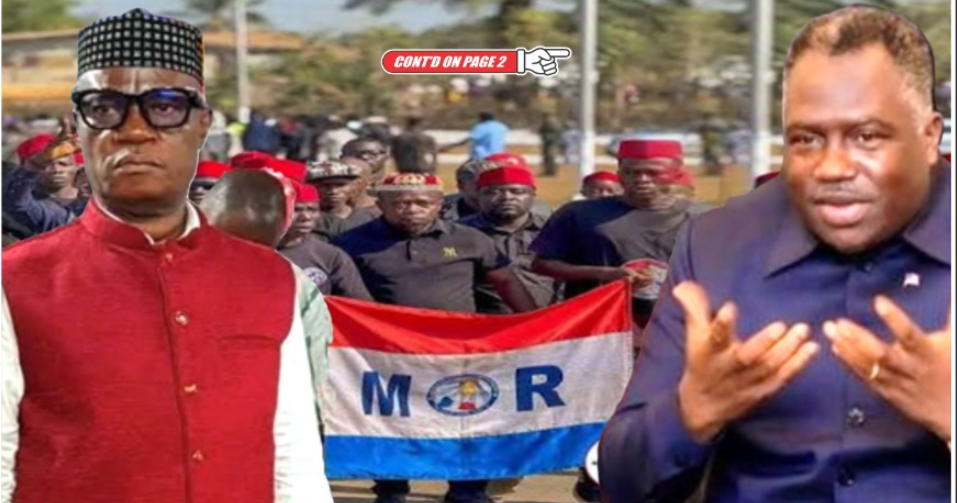
MONROVIA – The political saga between Nimba County Senator Samuel Gongben Kogar and Vice President Jeremiah Kpan Koung, heightened this week as Senator Samuel Gongben Kogar’s public acknowledgment of willingness to accept a vice-presidential running mate offer from opposition leaders triggered a 24-hour ultimatum from the youth wing of his own party, the Movement for Democracy and Reconstruction.
The confrontation between Senator Kogar and Vice President Jeremiah Kpan Koung comes as the most significant rupture within the MDR since the death of its founder, the late Senator Prince Yormie Johnson, who for decades served as the undisputed political godfather of Liberia’s second most populous county.
Senator Kogar, who ascended to the Senate following Johnson’s passing, has openly declared that he would not immediately reject an approach from opposition political figures seeking him as a vice-presidential candidate for the 2029 presidential elections, a statement that party loyalists have interpreted as a direct challenge to Vice President Koung’s presumed leadership of the MDR.
During a Monday morning radio appearance on OK FM on August 3, 2026, the Nimba County lawmaker sought to clarify his political posture while simultaneously acknowledging that his future remains open to various possibilities, provided that any decisions are made with transparency and prior consultation with his constituents.
The senator emphasized that he has no intention of conducting secret negotiations or making behind-the-scenes arrangements that would circumvent the trust of Vice President Koung or the people of Nimba County, insisting that his political conduct would remain above reproach.
“If tomorrow an opposition political leader approaches me and asks me to be a running mate, I won’t immediately say no,” Kogar declared during the broadcast. “The first thing I will do is inform the Vice President and the people of Nimba. I will go to him personally and say, ‘This person has asked me to be a running mate.’ I will never do anything behind anyone’s back.”
The senator further articulated a pragmatic view of Nimba County’s political fortunes, arguing that regardless of which citizen of the county occupies the vice presidency, the broader constituency stands to gain from such representation at the highest levels of national government.
“If a Nimba citizen becomes Vice President, Nimba benefits,” Kogar stated. “If I become Vice President, Nimba benefits. The vice presidency remains with Nimba.”
Despite his openness to future political opportunities, Senator Kogar vigorously denied that he is actively campaigning for the nation’s second-highest office, maintaining that any consideration for leadership positions should flow naturally from one’s record of integrity, public service, and relationship with the Liberian people rather than through self-promotion.
“I’m not campaigning for the position or blowing my own trumpet,” the senator asserted. “If anyone considers me, it should be because of my conduct and my relationship with the Liberian people—not because I promoted myself.”
The lawmaker further pledged that whatever political decisions he makes in the future would be conducted with full transparency, acknowledging that such choices may generate disagreement from various quarters but insisting that openness would characterize his approach.
“Whatever decision I make, I will be open and transparent,” Kogar said. “I won’t do anything secretly or dishonestly. I know some people will disagree with my political decisions, and that’s normal.”
Addressing recent public discussions surrounding his meetings with political figures outside his party, Kogar clarified that his engagement with businessman and opposition leader Alexander B. Cummings should not be misinterpreted as a vice-presidential arrangement or any formal political negotiation.
According to the senator, Cummings merely invited him to participate in discussions and future political engagements around the country, but no offer regarding the vice presidency was ever extended during their interactions.
“People say I’m positioning myself for the vice presidency, but that’s not the case,” Kogar explained. “Cummings invited me, I visited him, and we discussed working together. He never proposed anything to me. He only said that whenever he travels across the country, I should be part of the conversation and the tour. I agreed, but I haven’t even done that yet.”
The senator also disclosed that former President George Manneh Weah has never held similar political discussions with him, noting that the only occasion he visited the former president’s residence was when the property experienced a fire incident.
Despite the mounting tensions within the MDR and criticism from some party officials over his political posture and public comments, Kogar reaffirmed his commitment to the party and dismissed suggestions that he intends to abandon the organization. “Finally, I will not leave the MDR,” the senator declared. “I think they will get tired of me, but I will remain there.”
The senator’s comments have intensified existing divisions within the MDR, particularly as Vice President Koung is widely expected to contest the 2029 presidential election and is regarded by many loyalists as the party’s natural political leader following Johnson’s passing.
Following the death of the late Senator Prince Yormie Johnson, Senator Kogar emerged as one of the MDR’s most senior political figures in Nimba County, and despite reports of internal disagreements, he has repeatedly reaffirmed his loyalty to the party.
The ceremonial presentation of a symbolic elder hat to Senator Kogar during the MDR National Youth Retreat in Ganta City on July 18, 2026, has now become the focal point of the escalating confrontation between the senator and the party’s youth wing.
The hat, presented by MDR Nimba County Chairman Austin Dayneah on behalf of the National Youth Congress, was described during the ceremony as the “Symbol of the Elder,” representing wisdom, peace, leadership, unity, and responsibility.
Youth leaders urged Kogar to wear the hat as a reminder of his obligation to promote peace within the MDR, foster unity among party members, and help preserve the political legacy of the late Senator Prince Yormie Johnson.
In addition to receiving the ceremonial hat, Senator Kogar was presented with a certificate of appreciation in recognition of his contributions to youth empowerment and leadership development within the party.
However, the presentation immediately generated controversy within the MDR, with some party members interpreting the gesture as an unofficial endorsement of Senator Kogar as the party’s future standard-bearer.
Supporters of Vice President Jeremiah Koung strongly rejected that interpretation, insisting that Koung remains the MDR’s legitimate political leader and presumptive standard-bearer, exposing growing divisions within the party over its future leadership and political direction.
Despite the controversy, Senator Kogar continued to publicly wear the symbolic youth hat, including during the Nimba Kwado leadership induction ceremony, an appearance that further fueled speculation about his political standing within the party.
Now, the National Youth Congress Chairperson of the MDR, Czar Paley, has issued a 24-hour ultimatum demanding that Senator Kogar publicly withdraw his vice-presidential remarks and immediately surrender the symbolic elder hat along with any other materials presented to him by the Youth Congress.
Paley warned that failure to comply within the stipulated period would result in what he described as “public embarrassment” and unspecified “revolutionary action” by the party’s youth wing.
“The hat was given to him to serve as an ambassador of peace and unity within the Movement for Democracy and Reconstruction,” Paley said. “Instead, his recent statements have created confusion, division, and unnecessary political tension among party members.”
Paley argues that Kogar’s recent vice-presidential ambition contradicts the very principles of unity and reconciliation the Youth Congress sought to promote when it honored him with the symbolic elder hat.
Genesis of the saga:
The political saga between Senator Kogar and Vice President Koung centers on the leadership and future of the MDR, coming amid an intense struggle for political supremacy in Liberia’s most voter-rich county following Johnson’s passing.
The fallout exploded into the public domain following Kogar’s election to the Liberian Senate to fill the vacancy left by Johnson, and upon ascending to the Senate, Kogar claimed the mantle of “Godfather of Nimba” with the backing of traditional elders, positioning himself as a grassroots tribal leader.
This directly collided with the authority of Vice President Koung, who serves as the national political leader of the MDR and the second-highest official in the country. Senator Kogar has publicly accused Vice President Koung of treating him like a “bag boy” rather than an elected senior senator, disregarding Kogar’s input and stepping on Nimba’s neck by handpicking county officials for national appointments under President Joseph Nyuma Boakai’s administration.
The lawmaker has also alleged misuse of Nimba County Development Funds and claimed that Koung pressured him to remain neutral in the representative by-election for Nimba’s District Five, the seat Kogar vacated, thereby undermining his local autonomy.
The tension deepened during the lead-up to the August 12 by-election in District Five, where although the MDR and Unity Party alliance fielded Representative Kortor Kwagrue, both Kogar and Koung were heavily criticized by party activists for distancing themselves from the official MDR candidate.
Kogar officially declared neutrality to avoid regional division, but behind the scenes, Representative Kwagrue accused Senator Kogar of actively working to undermine him because Kogar believed Kwagrue was a proxy heavily backed by Vice President Koung.
While Vice President Koung has downplayed the conflict in public radio appearances, claiming there is zero conflict and that he views Kogar as a brother, the reality on the ground remains deeply fractured. Traditional chiefs and elders of Nimba County have attempted to intervene to broker a peace settlement, but Senator Kogar rejected initial mediation attempts.
The senator apologized to the traditional council for airing the county’s internal laundry on public radio but refused to meet at Vice President Koung’s residence due to trust issues. Kogar has insisted that any reconciliation must take place transparently on native Nimba soil in strict compliance with tribal tradition, a condition that has further complicated efforts to resolve the growing rift.