

-As ActionAid Report Exposes Global Injustice
By Vaye A. Lepolu
Monrovia: Liberia’s public debt has skyrocketed by 317.5 percent since 2014—from US2.84 billion—while the country contributes less than 0.03 percent of global emissions, according to a new ActionAid report that lays bare the stark inequity of climate financing and calls for urgent debt relief for vulnerable nations.
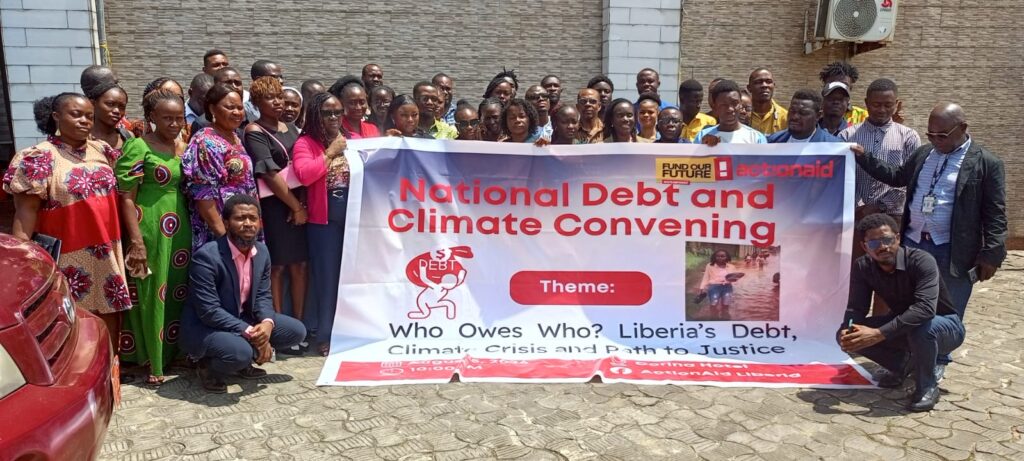
ActionAid Liberia launched its National Climate Debt Audit Report on Wednesday under the theme “Who Owes Who? Liberia’s Debt, Climate Crisis and Path to Justice,” arguing that countries least responsible for climate change are bearing its heaviest financial burden.
The report reveals that in 2025 alone, 18.65 percent of domestic revenue—nearly one in every five government dollars—was consumed by debt servicing, diverting critical funds from healthcare, education, agriculture, water sanitation, and climate adaptation. It also identifies a US213 million of US$573 million in committed climate funds actually disbursed.
“Today is about amplifying the voices of those on the frontlines of the climate crisis and strengthening our collective power to demand a future rooted in justice, equality, and accountability,” said ActionAid Liberia Country Director Elizabeth Gbah Johnson at the launch.
Johnson framed the report as both a research publication and a moral challenge to industrialized nations, whose historical emissions have generated vast economic growth while leaving developing countries to borrow for climate adaptation and disaster recovery. She stressed that women, girls, and persons with disabilities bear the disproportionate impact of underfunded public services and climate shocks.
“For ActionAid, this is fundamentally about climate justice, debt justice, economic justice, and gender justice. Countries and communities on the frontlines should not be forced to pay for a crisis they did not create,” she said.
She called for grant-based climate financing over loans, and urged full inclusion of women, youth, and affected communities in climate decision-making.
EPA chief urges domestic accountability
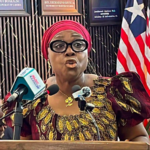
Environmental Protection Agency Executive Director Dr. Emmanuel Urey Yarkpawolo echoed calls for stronger international support but also stressed the need for domestic transparency. He described climate change as a security, human rights, and development threat, warning that every disaster diverts public resources from long-term investment to emergency response.
Reaffirming the principle of common but differentiated responsibilities, Yarkpawolo said developed countries must provide predictable, adequate, and accessible finance for mitigation, adaptation, and loss-and-damage initiatives. However, he urged Liberia to strengthen public financial management, procurement systems, and anti-corruption efforts to ensure climate resources reach intended communities.
He also highlighted Liberia’s forests, coastal ecosystems, and blue carbon resources as strategic assets capable of attracting sustainable climate investment while supporting biodiversity and livelihoods.
Report findings at a glance
· Liberia contributes less than 0.03% of global greenhouse gas emissions
· Public debt rose from US2.84 billion (June 2026)
· Debt servicing consumed 18.65% of domestic revenue in 2025
· Climate finance gap: US$360 million under NDC 2.0
· Only US573 million committed has been disbursed
Johnson thanked consultant Edward Nisan, the Ministry of Finance, EPA, Central Bank of Liberia, and development partners including the Embassy of Ireland, UNDP, and UN Women for supporting the research. She urged government, civil society, youth groups, academia, and partners to use the report as a foundation for advocating fairer international financing systems.
Closing the event, she called for concrete action through stronger partnerships, urging stakeholders to transform dialogue into policy change that prioritizes citizens over debt obligations.