

By: Jessica Cox
Liberia The Monrovia Consolidated School System (MCSS) has announced a series of reforms targeting teacher regularization, professional development, school infrastructure, student welfare and digital administration, as the institution seeks to strengthen public education in Monrovia.
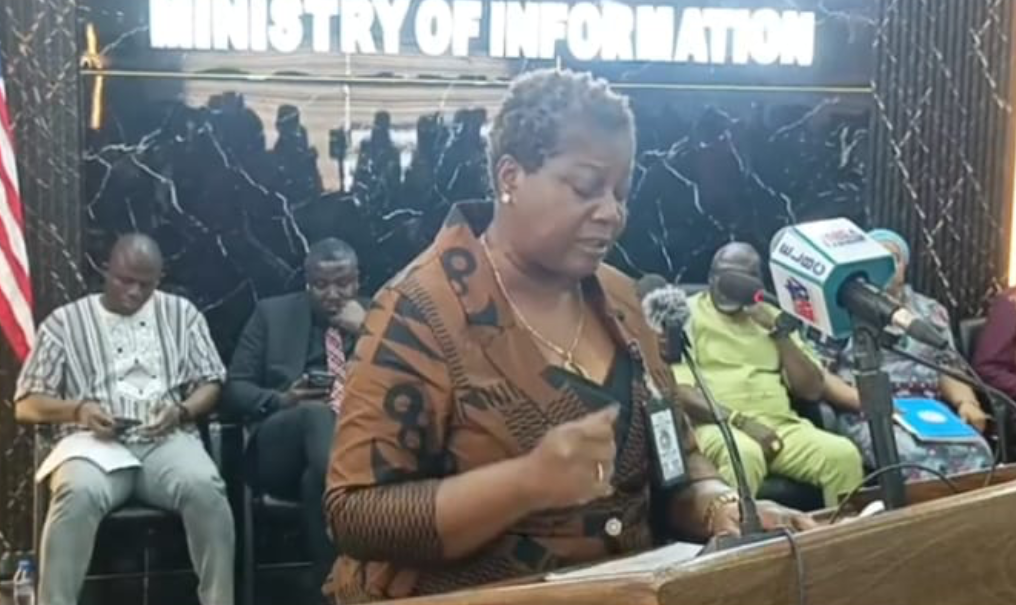
MCSS Superintendent Dr. Augurie E. Stevens made the disclosures Tuesday at the Ministry of Information, outlining measures she said are intended to improve teacher welfare, expand training opportunities and address infrastructure and administrative challenges confronting the public school system.
Among the measures announced are efforts to place qualified volunteer teachers on the Government of Liberia payroll, international training opportunities for MCSS teachers, scholarships for students, rehabilitation and expansion of school facilities, and development of a digital employee-management system.
Stevens said the payroll initiative is being pursued in collaboration with the Civil Service Agency and the Ministry of Education and remains subject to verification and the completion of required personnel procedures.
The move comes against the background of a longstanding volunteer-teacher issue within MCSS.
Public information from the Civil Service Agency indicates that 704 reported MCSS volunteer teachers were assessed, with 459 identified as qualified and legitimate. MCSS subsequently announced the onboarding of 208 qualified volunteers.
The different figures represent stages in the verification and payroll process, making the current status of all 459 qualified teachers an important question for the system.
MCSS has not, in the material reviewed for this story, provided a consolidated public breakdown showing how many of the 459 qualified teachers have completed payroll placement and how many remain under processing.
The issue is significant because volunteer teachers have previously raised concerns over employment and compensation, while the Government of Liberia has continued efforts to regularize qualified volunteer teachers nationally.
Beyond payroll, Stevens announced an international professional-development initiative involving 90 MCSS teachers, who she said will receive government-supported opportunities to pursue further studies in India.
According to Stevens, the package will cover tuition and round-trip airfare, with the teachers expected to return to Liberia after completing their studies and be assigned to MCSS schools to apply the knowledge and skills acquired.
If implemented as announced, the initiative could strengthen teacher capacity in MCSS, particularly in critical subject areas.
However, details concerning the participating institutions, fields of study, total program cost, duration and selection criteria were not included in the Superintendent’s remarks.
Stevens also disclosed that 11 MCSS students have received international scholarships through the Ministry of Education and are currently studying at Our Lady of Grace National School.
The scholarship initiative represents another component of the system’s effort to expand opportunities for students beyond the regular MCSS classroom environment.
MCSS has also introduced a new Early Childhood Development Program, according to the Superintendent.
Infrastructure remains another major component of the reform agenda.
Stevens said MCSS is undertaking rehabilitation and expansion projects aimed at improving learning environments and addressing overcrowding.
Among the projects she highlighted is the planned elevation of LPRC-Lapassy Elementary and Junior High School to senior high school level.
She also cited additional construction at Pipeline Junior High School, including facilities intended to address overcrowding.
Separately, rehabilitation work involving G.W. Gibson High School, Matilda Newport Junior High School and Boatswain Junior and Senior High Schools has been publicly reported as part of the Government of Liberia’s investment in MCSS infrastructure.
The infrastructure push provides a tangible measure of the administration’s reform agenda, but questions remain over project costs, completion timelines and the number of schools that will ultimately benefit.
For parents and students, the success of the projects will be measured not simply by announcements or groundbreaking ceremonies, but by whether they result in safer, less crowded and better-equipped learning environments.
Stevens said the institution is developing an Employee Management System designed to strengthen personnel records, transparency and accountability.
The system is also expected to support asset management, auditing and broader institutional operations.
For an institution that has faced challenges involving personnel verification and volunteer teachers, an accurate and regularly updated digital employee database could provide an important management and accountability tool.
The key test, however, will be whether the system is fully implemented and used to improve personnel management across MCSS schools.
Stevens acknowledged that MCSS continues to face challenges, including overcrowded classrooms, infrastructure gaps and limited resources.
She nevertheless said the administration remains committed to improving the quality of education and building systems that can be sustained beyond the current leadership.
The Superintendent’s reform agenda comes after she assumed leadership of MCSS in January 2026, with a stated focus on stabilizing, reforming and transforming the institution.
Her administration has identified personnel management, infrastructure, institutional accountability and teacher welfare as important areas requiring attention.
The reform agenda also comes amid a recent dispute over a statement published by Verity Online News and attributed to the MCSS Teachers’ Association.
In an August 3, 2026 clarification, MCSS said the statement was unsigned and did not represent the official position of the MCSS Teachers’ Association.
The institution said it was reviewing the contents and considering possible legal action against Augustine N. Nyormui and Emmanuel M. Dickson, whom it named in connection with the publication, if the claims were determined to be false and defamatory.
Superintendent Stevens said MCSS would pursue appropriate legal and administrative channels to address what it described as an attempt to misrepresent the Teachers’ Association’s views and damage the reputation of the institution and its leadership.
Because MCSS disputes the authenticity and origin of the statement, its allegations should not be presented as established facts.
The breadth of the reforms announced by MCSS suggests an attempt to address several longstanding challenges at once from teacher regularization and professional development to infrastructure and digital administration.
But the administration will ultimately be judged by implementation.
How many of the qualified volunteer teachers are now fully on government payroll?
How will MCSS measure the impact of the 90-teacher India training program?
What are the budgets and completion dates for the infrastructure projects?
How will the digital employee-management system improve accountability?
And what measurable changes will parents and students see in their schools?
Those questions do not diminish the reforms announced by MCSS. Instead, they provide benchmarks against which the administration’s performance can be assessed.
For MCSS, the central challenge is now to demonstrate that the reforms announced from the podium can translate into better-resourced schools, better-supported teachers and improved learning opportunities for students across Monrovia.