

-Senator Chea Condemns AFL Presence at South Beach as Guinean Troops Occupy Liberian Soil
By Jerromie S. Walters
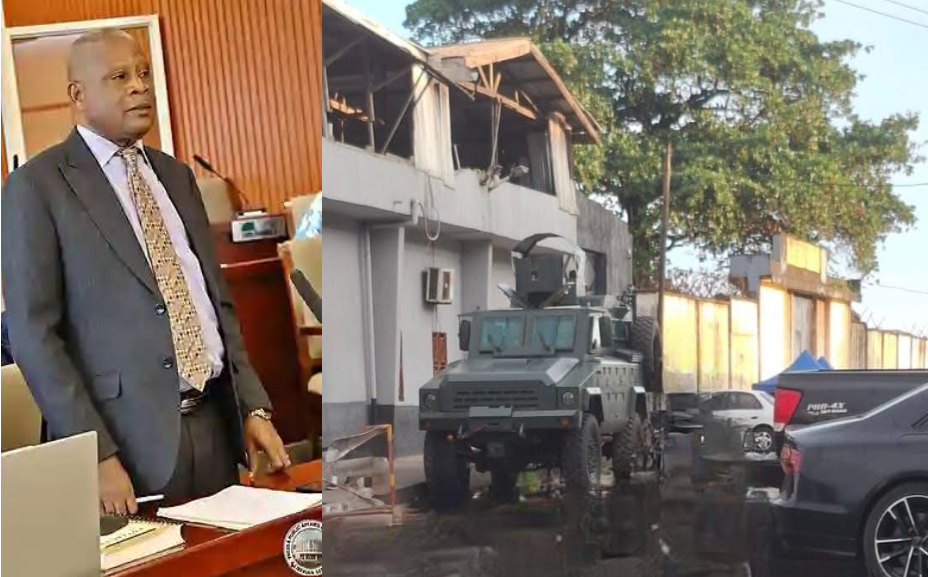
MONROVIA — Senator Augustine Chea on Wednesday accused the Boakai administration of deploying military resources against a political detainee while failing to secure Liberia’s border, warning that the Armed Forces of Liberia risks repeating the “ugly, unprofessional, and dangerous” patterns that eroded public trust before the civil war.
The Senate Judiciary Committee chairman condemned the AFL armored personnel carrier stationed outside Monrovia Central Prison, where former Vice President Jewel Howard-Taylor remains detained, as Guinean soldiers continue to occupy Liberian territory along the northeastern border—a crisis Chea says exposes a troubling irony in the government’s security priorities.
“The deployment of an AFL armored personnel carrier at the Monrovia Central Prison raises questions about the Boakai administration’s priorities at a time when our country continues to face serious security threats at the border with Guinea,” Chea wrote in a sharply worded statement.
The senator emphasized that the military’s primary mandate requires defending the Republic and protecting its territorial integrity—not serving “as an instrument of intimidation, political pressure, or partisan interests.”
“Liberia has experienced enough in the past in which the instruments of state power were turned inward against citizens,” Chea warned. “The AFL must therefore be seen as a national institution, not as an extension of the governing party or an instrument for settling political disputes.”
Chea stressed that such actions eroded public confidence in the Army during the pre-civil war era and “severely tarnished its reputation.” The AFL “must never, under any circumstances, tread that same ugly, unprofessional, and dangerous path again,” he added.
Guinean Troops Remain on Liberian Territory
The senator’s concerns underscore a simmering border crisis that diplomatic efforts have failed to fully resolve. Guinean soldiers remain stationed on Liberian soil nearly six months after the dispute erupted, despite President Joseph Boakai’s assurances that negotiations had resolved the matter.
The confrontation began on March 2, 2026, at the Sorlumba border point in Foya District, Lofa County, when Guinean soldiers crossed into Liberian territory and halted sand-mining operations by a Liberian company, BK Enterprise. Guinea claimed ownership of the Makona River and declared the mining unauthorized.
Guinean troops then removed a Liberian flag from the riverbanks and raised their own. Local youth retaliated by tearing down the Guinean flag, prompting Guinea to deploy reinforcements and aerial support along the border, triggering massive panic among residents.
The dispute stems from ambiguous colonial-era treaties dating back more than a century. While the 1907 agreement between France and Liberia modified the border to follow geographic markers like the Makona River, Guinean authorities now claim ownership of the water and an additional 800 meters of land extending inland onto the Liberian side.
The standoff forms part of a larger regional security challenge, as Guinea simultaneously locks horns with Sierra Leone over the nearby Yenga territory, raising fears that the tensions could destabilize the entire Mano River Basin.
Diplomacy Fails to Dislodge Guinean Forces
Following the March escalation, Liberia’s Internal Affairs Minister Francis Sakila Nyumalin led a 43-person delegation to Guinea, where both sides agreed to return the Liberian flag to its previous checkpoint. President Boakai traveled to Conakry for emergency talks with Guinean President Mamadi Doumbouya, resulting in a tripartite agreement to return to the status quo.
The ECOWAS Commission deployed a technical assessment mission to formally survey the border, and leaders pledged to use the Mano River Union framework to finalize boundary lines. Liberian officials assured citizens the matter had been resolved.
Yet Guinean soldiers remain on Liberian soil, leaving the border dispute unresolved and raising questions about the government’s capacity to defend national territory.
Howard-Taylor Faces Drug Trafficking Charges
The former vice president was detained early Wednesday morning at Roberts International Airport while attempting to depart the country, in connection with allegations of involvement in a transnational cocaine trafficking network.
According to a writ of arrest filed by the Ministry of Justice, Howard-Taylor allegedly maintained links with a cocaine trafficking organization that used Liberia as a transit point for shipments destined for Europe. The complaint alleges activities dating from 2021 through 2026, involving foreign nationals and Liberian intermediaries.
The former vice president faces seven criminal counts: unlicensed importation of a controlled substance, unlicensed sale and transportation, illicit trafficking, criminal solicitation, facilitation, conspiracy, and money laundering. Each count carries significant prison time upon conviction.
The government alleges that Croatian and Ukrainian nationals—Taras Zadereiko, also known as “Tony,” and Mihovil Vrovac, also known as “Michael”—were brought to Liberia by Sheik Bashiru Kante, who prosecutors claim introduced them to Howard-Taylor in 2022 while she served as vice president. The complaint alleges Taylor met the men at her Congo Town residence.
Prosecutors further claim that Howard-Taylor traveled to Dubai, where she allegedly met Nikola Ivancic, described as the alleged kingpin of the cocaine trafficking organization. The government alleges discussions centered on using Liberia as a transit route, and that Taylor received $45,000 from Ivancic while shopping in Dubai.
According to investigators, Taylor later received $75,000 through Kante for her Jewel Star Fish Foundation, and an additional $15,000 in August 2026. Prosecutors claim an audio recording exists in which Taylor expresses appreciation to Ivancic.
Howard-Taylor categorically denied all charges, describing the case as a “politically motivated witch-hunt” and an abuse of state power.
In a statement released Saturday, her office rejected “in the strongest possible terms” all charges, stating that “these allegations are baseless, unfounded, and without merit.”
Her legal team, including former Supreme Court Associate Justice Kabineh M. Ja’neh, maintains that Howard-Taylor was prepared to voluntarily report to Police Headquarters but security forces intercepted her vehicle while she traveled to meet her lawyers and escorted her to police custody.
“The former vice president’s office has also alleged that unnamed government figures may have contemplated using artificial intelligence to manufacture doctored audio and video recordings intended to implicate her, describing the allegation as ‘an extremely serious and alarming development.'”
Any audio or video evidence will undergo independent forensic examination, her office stated.
National Drug Crisis Deepens
The case unfolds against the backdrop of a devastating drug crisis. An estimated 13% of Liberia’s population engages in illicit drug abuse, with up to 20% of the country’s youth suffering from substance addiction—rates enormously higher than the global average, driven by post-conflict trauma and lack of employment.
President Boakai declared his administration would pursue the fight against illicit drug trafficking and organized crime with “deliberate, coordinated, and unrelenting” resolve.
In an address to the nation Wednesday evening, Boakai emphasized that “no office, status, or political connection would shield anyone from justice,” framing the crackdown as a moral and national security imperative rather than a political vendetta.
“This Administration will enforce the law without fear or favor while protecting the constitutional rights of every person,” Boakai said. “Whether one has held high office, served in government, led a business, or lived as an ordinary citizen, the law must apply equally to all.”
However, the President’s pledge of impartial justice has been complicated by separate allegations that have surfaced against some of his own top security officials. Claims on social media have linked Justice Minister Cllr. N. Oswald Tweh Sr. and Liberia National Police Inspector General Gregory Coleman to a drug cartel.
Additionally, the president’s son, Jojo Boakai, has been accused of maintaining a close relationship with the alleged cartel. None of these individuals, including Boakai Jr., has been added to the ongoing investigation, raising questions about the administration’s commitment to equal application of the law.
All allegations against Howard-Taylor remain unproven in court. She is entitled to the presumption of innocence until proven guilty.