

-Aspiring AFL Recruits Say, As They Flock to BTC Barrack
By Jerromie S. Walters
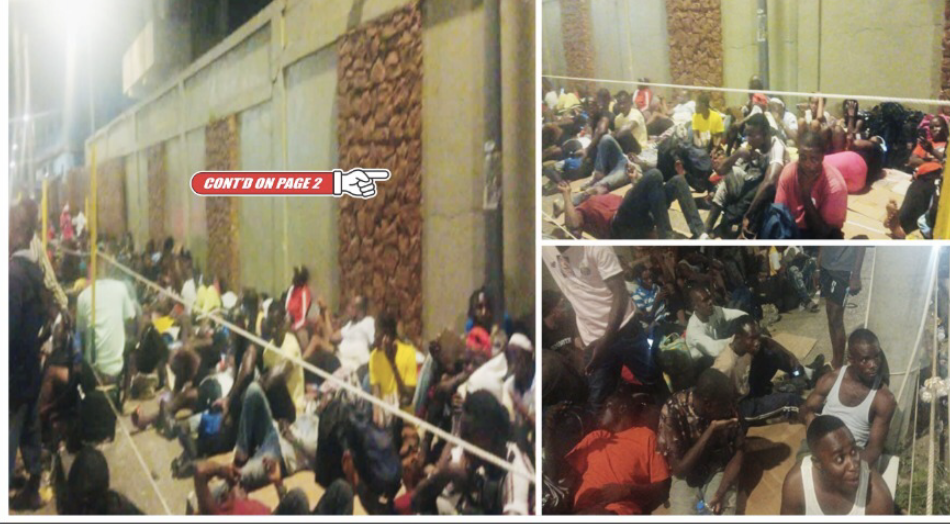
MONROVIA — Dozens of Liberians, including a notable number of female applicants, assembled at the Barclay Training Center (BTC) on UN Drive days before the official start of the Armed Forces of Liberia (AFL) 2026 recruitment process. The early arrivals, many of whom slept at the barracks to secure their places, say their primary motivation is a deep-seated desire to protect their nation.
The AFL 2026 recruitment exercise officially commences today, April 27, 2026, and is scheduled to run through June 27, 2026. However, by Friday, April 24, 2026, a large crowd of prospective recruits had already gathered at the BTC barracks. Several among them remained on the premises overnight. Among the early arrivals is Stephen Zedee, who says his interest in joining the military is driven by a sense of national duty rather than the prospect of financial gain.
“We came to make sacrifice for our country… to defend our country. It is for passion and not ready for money,” he said. Zedee further explained that his aspiration to join the army dates back to his high school years. He described the decision as a lifelong dream, adding that the opportunity to serve in uniform represents a personal commitment to Liberia’s security and sovereignty.
Another applicant, Chris Toby, a resident of District #1 in Grand Bassa County, offered a slightly different perspective. Toby acknowledged that while the need for employment is a significant factor, his desire to protect Liberian territory remains paramount. “It is about job opportunity, number one and then to protect our country,” he stated.
Toby also linked his motivation to ongoing border disputes, specifically mentioning tensions between Liberia and Guinea. He expressed concern over what he views as encroachment on Liberian land and stressed the importance of territorial integrity. “If you take this land from me, where do you expect me to go?” he asked.
The Recruitment Process:
To be eligible to join the Armed Forces of Liberia AFL), applicants must be Liberian citizens and must be between the ages of 18 and 35 years old. Each candidate must have at least a high school diploma and must also possess a WAEC or WASSCE certificate. All applicants are required to be physically and medically fit and must provide a valid health certificate from a recommended medical institution, noting that the certificate must have been issued within three months of the application date.
Candidates must also be cleared of any human rights abuses or violations. The required documents include a National ID card, a Liberian passport, a birth certificate, or a certificate of naturalization, as well as two passport-size photographs with a white background. The recruitment screening will take place across four regions. For Region 1, screening will be held at the Barclay Training Center in Monrovia from April 27 to May 15, 2026.
For Region 2, screening will take place in Tubmanburg City, Bomi County, from May 18 to May 29, 2026. For Region 3, the screening will be held at the Gbarnga Sport Stadium in Bong County from June 1 to June 12, 2026. For Region 4, screening will be held at the Zwedru Multilateral in Grand Gedeh County from June 15 to June 20, 2026, and then in Harper City, Maryland County, from June 22 to June 27, 2026.
Amid border dispute:
The recruitment drive comes one month after tensions escalated along the Liberia-Guinea border. For days, residents of communities along the Makona River in northern Liberia have remained in a state of heightened fear and uncertainty as a territorial dispute with Guinea entered its second week on Tuesday, March 17, 2026.
The dispute began when Guinean soldiers crossed the Makona River, long regarded as the natural boundary, and seized equipment from a Liberian sand-mining operation. The troops raised a Guinean flag on Liberian soil, asserting territorial claims. Residents confronted the intruders and re-hoisted the Liberian flag, but the situation turned violent days later when Guinean forces returned and opened fire, wounding a Liberian man.
Despite a high-level emergency summit held the previous week in Conakry involving the presidents of Liberia, Guinea, and Sierra Leone, Guinean troops remained present in the contested area. Following the trilateral meeting convened under the Mano River Union framework, President Boakai said, “We all realized that we are the same people. We have been working together for years and we have nothing to gain from war.”
The summit produced a joint communiqué outlining a 12-point roadmap for peace, including commitments to restore the status quo ante and enhance security cooperation through joint patrols. However, the continued presence of Guinean soldiers on disputed ground has left many Liberians questioning the effectiveness of the diplomatic breakthrough.
Reports also indicate that at the Sefudu Border in Quardu Gbondi District, Guinean security personnel ordered their Liberian counterparts to move the Liberian flag approximately half a kilometer from the swampy borderline in 2025. That incident is regarded as the first known instance of attempted encroachment, suggesting a broader pattern of gradual territorial expansion.
The Makona River, also known as the Moa, is an international waterway shared by Liberia, Guinea, and Sierra Leone. Guinean authorities cite the 1907 Franco-Liberian Convention and a 1911 refinement, which they interpret as placing the border along the Liberian bank rather than the middle. They also invoke a regional principle suggesting that a border river belongs to the country where it originates, which in this case is Guinea. Conversely, Liberian local leaders and residents maintain that the river has historically served as a recognized shared boundary, with Liberian territory extending to at least the middle of the river.
The Armed Forces of Liberia
The Armed Forces of Liberia trace their origins to a militia formed by early Americo-Liberian settlers in the 19th century. The force was formally established as the Liberian Frontier Force in 1908 and renamed in 1956. For much of its history, the AFL has received significant material and training assistance from the United States. Between 1941 and 1989, this support was largely provided by U.S. advisers. However, a RAND Corporation assessment found that U.S.-supported training initiatives during the 1980s did not produce measurable improvements in the AFL’s overall training and professionalism.
During the Cold War, the AFL saw little action, apart from a reinforced company group deployed to the United Nations Operation in the Congo (ONUC) in the 1960s. That changed with the outbreak of the First Liberian Civil War in 1989. The AFL became entangled in the conflict, which lasted from 1989 to 1997, followed by the Second Liberian Civil War from 1999 to 2003.
As of the mid-2010s, the AFL consists of an infantry brigade, an air wing, and a coast guard. For several years after the war, a Nigerian Army officer served as head of the armed forces. February 11 is observed as Armed Forces Day, officially proclaimed a national holiday in 2011.
The modern Armed Forces of Liberia grew out of a militia formed by the first Black colonists from the United States. The militia was first established in August 1822 when an attack was feared on Cape Mesurado, where Monrovia now stands. The agent of the settlements directed the mobilization of all able-bodied males into a militia and declared martial law.
By 1846, the militia had grown to two regiments. Following independence in 1847, the militia continued to serve as the country’s defense force, modeled after the United States Army. In 1900, Liberian men between the ages of 16 and 50 were considered liable for service in the militia. The militia also had a navy consisting of two small gunboats. In the 1850s, the Liberian president requested naval support from the British government to transport Liberian troops to the Gallinas territory to punish Liberians there who persisted in slave trafficking.
On February 6, 1908, the militia was established on a permanent basis as the 500-strong Liberian Frontier Force (LFF). The LFF’s original mission was to patrol the border in the hinterland against British and French territorial ambitions and to prevent disorders. The LFF was initially placed under the command of British Major MacKay Cadell, who was quickly replaced under threat of arms after he complained the force was not being properly paid.
In 1912, the United States established military ties with Liberia by sending five Black American officers to help reorganize the force. In its early years, the LFF was frequently recruited by forcible induction of men from the interior. When dispatched to the interior to quell tribal unrest, units often lived off the areas they were pacifying as a form of communal punishment. The force’s officers were drawn from either the coastal aristocracy or tribal elites.