

–On Tackling Liberia’s Drug Crisis
By Jerromie S. Walters
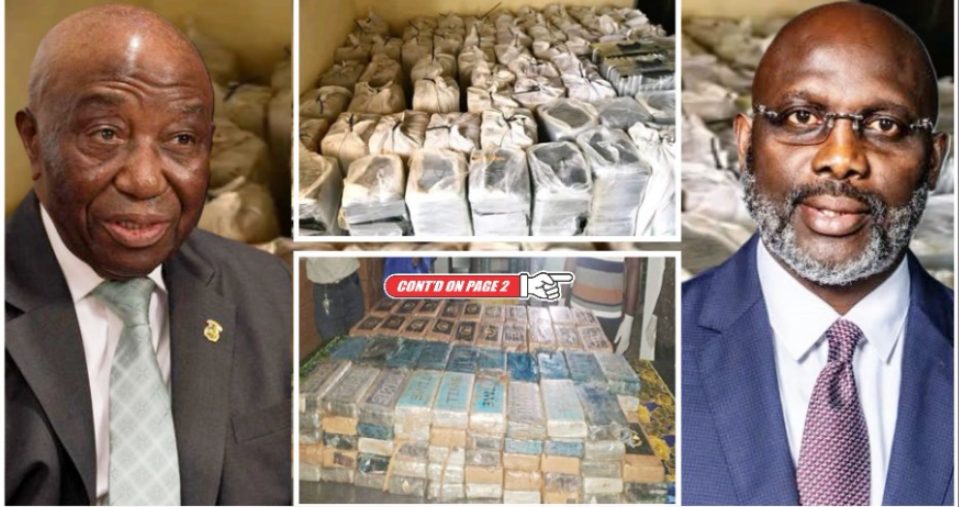
MONROVIA — Former President George Manneh Weah has extended his best wishes to the Boakai-Koung administration in addressing Liberia’s escalating drug crisis, asserting that his own government successfully managed similar challenges during his tenure. The remarks come as Liberia grapples with its largest-ever cocaine seizure and faces a devastating domestic addiction epidemic that has driven thousands of young people into homelessness.
Speaking to journalists at a Congress for Democratic Change (CDC) engagement in the United States, Weah responded to questions about the crisis by stating, “Well, you know that drugs in any society is not a good thing, so I hope that the government can solve the drugs problem. When we had a little drugs issues we solve so I expect the government to do the same.”
The former president’s comments arrive amid a turbulent period for Liberia’s anti-narcotics efforts, highlighted by the incineration of 4.2 metric tonnes of cocaine valued at approximately US317 million in Duazon, just outside Monrovia.
The massive cocaine haul surpasses a previous record-breaking seizure of 520 kilograms valued at approximately US$100 million discovered in October 2022 at the Sonit Liberia Corporation compound in Monrovia. That earlier operation, coordinated with United States and Brazilian authorities, uncovered cocaine hidden among frozen goods shipped from Brazil and led to charges against four men of Liberian, Portuguese, Lebanese, and Guinea-Bissauan nationalities.
The current investigation began in March 2026, when 237.6 kilograms of cocaine valued at over US$19 million was discovered at Roberts International Airport inside cargo boxes falsely labeled as seasoning cubes. That investigation was later compromised after several principal figures fled the country during the probe.
The Ministry of Justice confirmed on July 22 that the Joint National Security Investigative Task Force is examining the origin, ownership, method of transport, and intended destination of the seized substances, as well as the identities and roles of all persons connected to the operation. Authorities have revealed that the investigation has uncovered an “organized, sophisticated, complex, and well-funded narcotics trafficking network” that may have been operating in Liberia for more than six years.
Police Inspector General Gregory Coleman recently disclosed that both former and current government officials are being investigated as cartel enablers. Coleman stated that the cartel has been operating since 2021 and that several senior police officers have been implicated for using police escorts to transport the drugs.
National Security Emergency
Drug abuse has remained a national health and security emergency in Liberia for years. According to the United Nations Population Fund (UNFPA), an estimated 13 percent of the general population abuses drugs, with approximately 20 percent—over one million—of young Liberians addicted to narcotic substances.
Liberia faces a severe dual drug crisis marked by a devastating domestic addiction epidemic involving the synthetic street drug “kush” and massive international cocaine trafficking operations using the country as a transit hub. The domestic crisis has driven thousands of young people into homelessness and street life, locally called “zogos,” prompting a public health emergency declaration.
The issue was a central theme in the 2023 presidential election campaign. The Unity Party, then in opposition, vehemently criticized the Weah administration’s handling of the drug crisis, using the spread of the synthetic substance “kush” as a campaign weapon against the former government.
The Weah administration had taken some steps, including the passage and signing of a non-bailable drug law and the June 2022 launch of a US1 million as the government’s contribution toward the program. However, the Unity Party argued these efforts were insufficient, and voters appeared to agree, choosing to replace Weah with Boakai in the November 2023 runoff election.
Former Vice President Demands Transparency
Weah’s comments came days after former Vice President Jewel Howard-Taylor demanded that the Liberian government release all court documents and investigative reports related to the record-breaking cocaine seizure, insisting that authorities acted “under a cloud of darkness” as they burned the massive drug haul in Careysburg.
“Hon Gaye, Government must be more transparent!” Howard-Taylor said in a direct response to EPS Director Sam Gaye. “If this has been done – it was done under the cloud of darkness. The issue of the large quantity of drugs on our shores concerns all of us. It’s still been done with a lack of transparency. If what you say is true, please issue the reports and court documents,” she added.
Earlier Thursday, before the burning, Howard-Taylor had warned that justice must not be sacrificed in the rush to destroy evidence. She demanded that authorities prove every legal and forensic requirement had been fully satisfied before any destruction proceeded, emphasizing that this was “not a call to preserve illegal drugs indefinitely but rather a call to preserve justice.”
EPS Director Sam Gaye responded to the former vice president’s concerns, stating: “Madam former VP, there are legal guidelines regarding the destruction of bulk drug evidence. The process was followed to the letter. Representative samples were collected for presentation in court. And the court legally authorized the destruction pursuant to law and international best practices.”
Howard-Taylor, while commending security institutions for intercepting the dangerous shipment before it reached Liberian communities or international markets, stressed that given the magnitude of the seizure and the indication that investigations remain active, it was imperative that the government first assure the Liberian people that every legal and forensic requirement has been fully satisfied before any destruction takes place.
Weah Signals 2029 Presidential Comeback
The former president’s latest statements on the drug crisis come amid his official declaration that he will run for the presidency in the 2029 general elections. During a keynote speech at the CDC USA Chapter Convention in Springfield, Pennsylvania, Weah explicitly stated, “I will be a candidate for the Presidency of Liberia in 2029.”
This clear announcement puts an end to prior speculation and mixed messages regarding his retirement from politics. Weah urged his supporters and members of the CDC to set aside internal grievances, unite, and reorganize their structures to prepare for what he described as a “political battlefield.”
In his address, he heavily criticized the sitting President Boakai and the ruling Unity Party. He claimed the current government’s “No Business As Usual” slogan is a bluff, accusing them of violating Liberian laws and mismanaging the country. Dismissing recent political losses and disputes over party property, Weah told his base to look forward, declaring, “Let us focus on building our new home, recalibrating, and get prepared to take back power in 2029 with no exceptions.”
In June of this year, Weah had already accused the Boakai administration of turning Liberia into a “narco state” during a public critique of the Unity Party government. Speaking before thousands of supporters via online in Zwedru, Grand Gedeh County, Weah used the 22nd anniversary celebration of his CDC to allege that drug trafficking networks operate with official protection while democratic institutions are being systematically weakened.
President Boakai’s Response
Since taking office on January 22, 2024, President Joseph Nyuma Boakai has declared the drug crisis a national emergency. In January 2024, he formed a Multisectoral Steering Committee to lead inter-ministerial efforts against drug trafficking and abuse. The government formally launched the National Anti-Drug Action Plan (2025–2030) in late 2025, a five-year framework initially budgeted at US$200,000 that unifies public health, security, and education initiatives.
Between 2024 and 2025, the Liberia Drug Enforcement Agency (LDEA) confiscated 9,651.23 kilograms of illegal substances valued at over US$4.9 million in nationwide operations. Several LDEA heads have been relieved of their posts by President Boakai for administrative reasons or failure to produce expected results.
In response to the June 8, 2026, US317 million drug saga, President Boakai dismissed top leaders of the LDEA and several airport and national security officials implicated or under investigation for aiding the trafficking networks.
Despite the Boakai administration’s anti-drug efforts, the crisis persists, and Weah now appears poised to use the issue against the current government in the same way the Unity Party used it against him during the 2023 election campaign. With the former president officially signaling his return to the political arena, the drug crisis is likely to remain a central battleground in Liberia’s ongoing struggle against narcotics trafficking and addiction.