

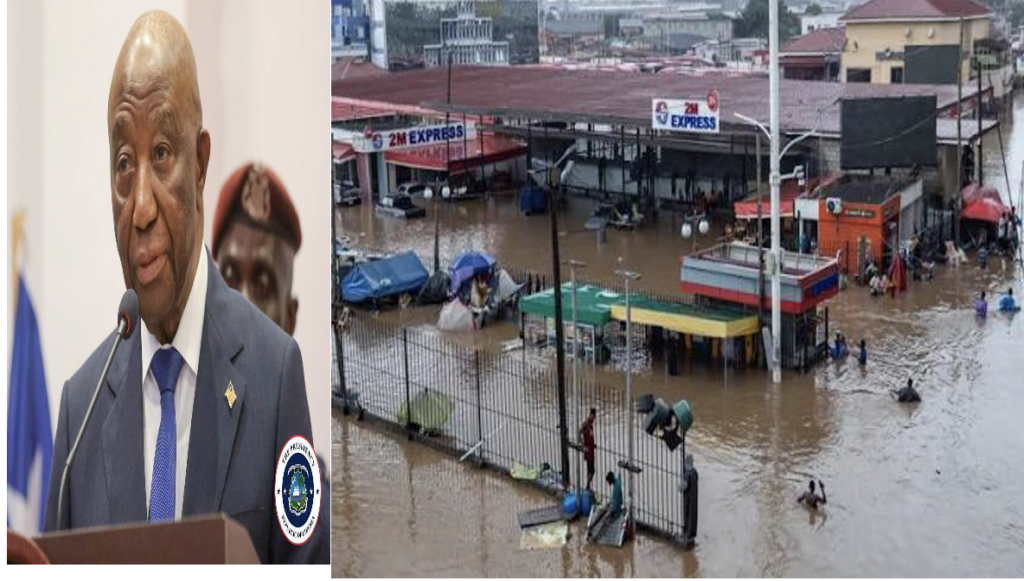
-Pres. Boakai Urges Liberians to Relocate From Flooded Communities
By Sampat JMB Kpakimah
Monrovia: President Joseph Nyuma Boakai has called on Liberians living in vulnerable coastal areas to relocate to safer communities, warning that devastating floods—like those currently ravaging Ghana—could strike Liberia at any time.
Speaking on Thursday, July 2, 2026, during the 21st Cabinet Meeting, the President said the government’s primary responsibility is to protect lives and property, even when difficult decisions are required. “You can fight fire, but not water,” President Boakai said, warning that floods and rising waters can become uncontrollable within a short period.
He acknowledged that some residents may resist or complain about relocation efforts but insisted that the government will continue encouraging movement from high-risk coastal communities because such actions are necessary to save lives. According to the President, while relocation may initially be unpopular, people will eventually understand that the government’s actions are intended to prevent future disasters.
“We have to be prepared to handle disasters,” President Boakai declared, calling on government ministries, agencies, and commissions to strengthen disaster preparedness and coordinate efforts to reduce the country’s vulnerability to flooding and other climate-related emergencies.
The President expressed deep concern over the recent devastating floods in Ghana, describing the disaster as a warning that Liberia must not ignore the growing threat posed by climate-related hazards.
President Boakai disclosed that he spoke with Ghanaian President John Dramani Mahama following the flooding, extending Liberia’s solidarity while reflecting on the scale of the disaster.
Severe flash flooding across southern Ghana has killed at least 13 people and displaced over 70,000 residents following unprecedented, record-breaking rainfall that began on the night of June 28, 2026. The downpour dropped over 169 mm of water in a single day, marking the fourth-highest daily rainfall recorded in the country since 1995.
The Liberian Leader noted that few people would have imagined Ghana facing such severe flooding, stressing that the tragedy should serve as a lesson for Liberia.
“Who would have known that Ghana would experience flooding today?” the President asked. He said the disaster illustrates that no country is immune from the effects of climate change and that Liberia must begin taking preventive measures before similar emergencies occur.
The President also used the Cabinet meeting to address the issue of official foreign travel in large numbers. He instructed that travel undertaken in connection with the country’s Sustainable Development agenda be discussed with the Ministry of Finance and Development Planning to ensure that government resources are used responsibly.
President Boakai said he does not like to prevent officials from traveling abroad because such engagements are important for advancing Liberia’s development agenda. However, he expressed concern about the size of some government delegations, particularly instances where four or five officials accompany a single trip.
He urged Cabinet members and heads of government institutions to exercise greater fiscal discipline by limiting unnecessary travel and ensuring that only essential personnel participate in official missions abroad.
For Liberia, the National Disaster Management Agency (NDMA) has warned that more than 100,000 people face significant risk from climate-related hazards during the 2026 rainy season. NDMA Public Relations Officer Archievego Menneah Doe confirmed the agency’s forecast on Friday, citing predictions of above-normal rainfall.
Meteorologists expect up to 15 inches of rain, with the most severe weather occurring during the peak months of August and September. The NDMA has identified 323 flood-prone communities nationwide, with Montserrado, Margibi, Grand Gedeh, Grand Bassa, and Sinoe counties facing the highest risk.
“It is anticipated that not less than 100,000 persons will be affected by climate-related hazards,” Doe said. He attributed much of the urban flooding to the encroachment on wetlands and ongoing deforestation, noting that rural areas with more vegetation suffer less severe consequences.
While the NDMA focuses on prevention and warnings, residents in impacted areas say the government must provide structural solutions. In the Neezoe community of Paynesville, flooding regularly disrupts daily life and forces schools to close. Community Chairperson Titus M. Sonyah acknowledged recent support from the Liberia National Red Cross Society and the Paynesville City Corporation, which provided cleaning tools to clear clogged drains. However, Sonyah said these measures are insufficient.