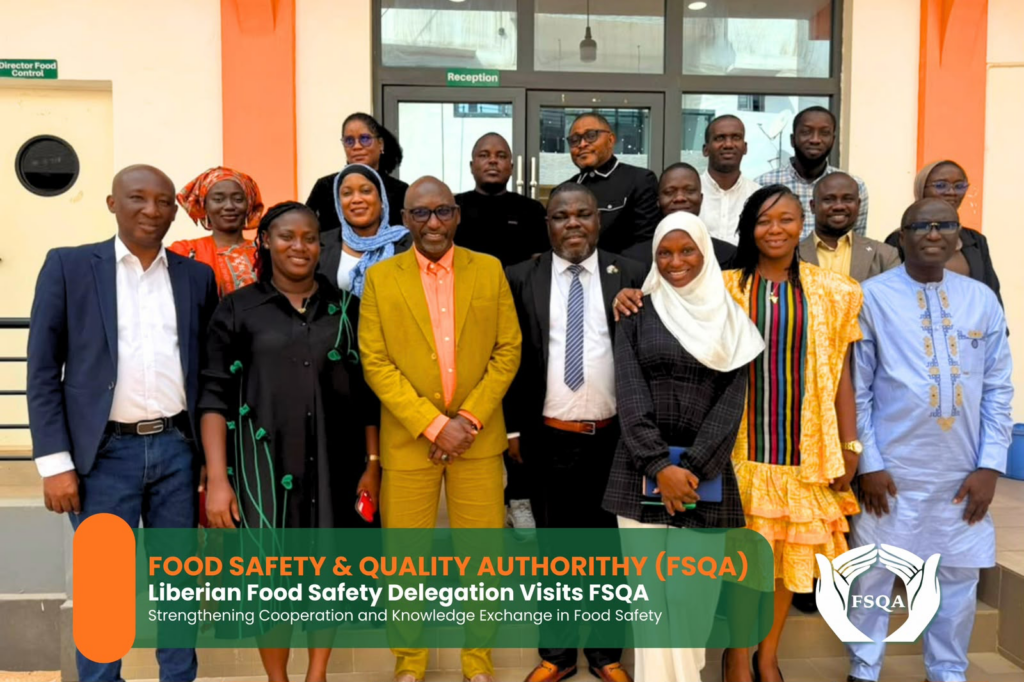
MONROVIA, Liberia — The Director General and Chief Executive Officer of the Liberia Standards Authority (LiSA), Hon. Stephen Yongar Mambu, is leading a high-level inter-agency delegation on a two-week study tour to The Gambia and Ghana aimed at strengthening Liberia’s food safety standards and improving the country’s capacity to compete in regional and international markets.
The tour, which runs from October 26 to November 7, 2026, is being conducted under the Liberian Food Safety Initiative (LiFSI), a European Union-funded project implemented by the United Nations Industrial Development Organization (UNIDO).
The nine-member Liberian delegation comprises five representatives from the Food Authority of Liberia (FAL), two from the National Fisheries and Aquaculture Authority (NaFAA), one member of the LiFSI project team, and a senior representative from LiSA.
The visit is intended to expose Liberian food regulatory institutions to established regional practices in food safety management, risk-based inspections, market surveillance, and quality assurance systems.
According to information released by LiSA, the study tour forms part of broader efforts to strengthen Liberia’s national food standards framework, improve regulatory coordination, and upgrade local testing laboratories to meet international accreditation requirements.
During the engagement, the delegation is expected to gain practical knowledge that will support the introduction of a voluntary third-party food safety assurance (vTPA) scheme in Liberia.
The proposed scheme is intended to certify local farmers, small businesses, primary producers, and agro-processors, enabling them to demonstrate compliance with recognized food safety and quality standards.
The initiative is also expected to enhance the competitiveness of Liberian products under the African Continental Free Trade Area (AfCFTA), which seeks to expand trade among African countries.
As part of the tour, Mambu and his delegation are engaging three major regulatory institutions: the Food Safety and Quality Authority (FSQA) of The Gambia, the Food and Drugs Authority (FDA) of Ghana, and the Ghana Standards Authority (GSA).
The technical engagements are particularly important for the recently operationalized Food Authority of Liberia, which is seeking practical lessons to implement its five-year Strategic Plan covering 2026 to 2030.
The delegation is examining how the two countries enforce food safety regulations, conduct risk-based inspections, apply preventive food safety management systems, and define the responsibilities of government inspectors and private-sector food operators.
The engagements are expected to provide practical guidance for translating Liberia’s food safety policies into enforceable regulations and effective institutional procedures.
LiSA says the initiative represents a shift from fragmented and largely uncoordinated food inspections toward an integrated, science-based, and legally supported national quality infrastructure.
“Liberia is moving away from basic, uncoordinated food inspections toward an integrated, science-based, and legally sound national quality infrastructure,” the LiSA Communications Office stated.
The office added that collaboration with regulatory institutions in Ghana and The Gambia would provide Liberia with proven approaches to protecting public health, safeguarding consumers against substandard imports, and increasing the market value of locally manufactured and processed products.
The study tour comes at a time when Liberia is seeking to strengthen its domestic production capacity, improve consumer protection, and position local businesses to benefit from expanding opportunities under continental trade arrangements.
However, the long-term impact of the initiative will depend on how effectively the knowledge and regulatory practices acquired during the tour are translated into national policies, institutional capacity, laboratory improvements, and consistent enforcement.
The tour is scheduled to conclude on November 7, 2026.