

-Aspiring AFL Recruits Blame Phobia for Poor Reading Performance
By Sampat JMB Kpakimah
MONROVIA — Some applicants taking part in the ongoing Armed Forces of Liberia (AFL) 2026 recruitment drive have attributed the poor reading performances displayed by several candidates last week to phobia rather than a lack of literacy skills, contrary to public assumption.
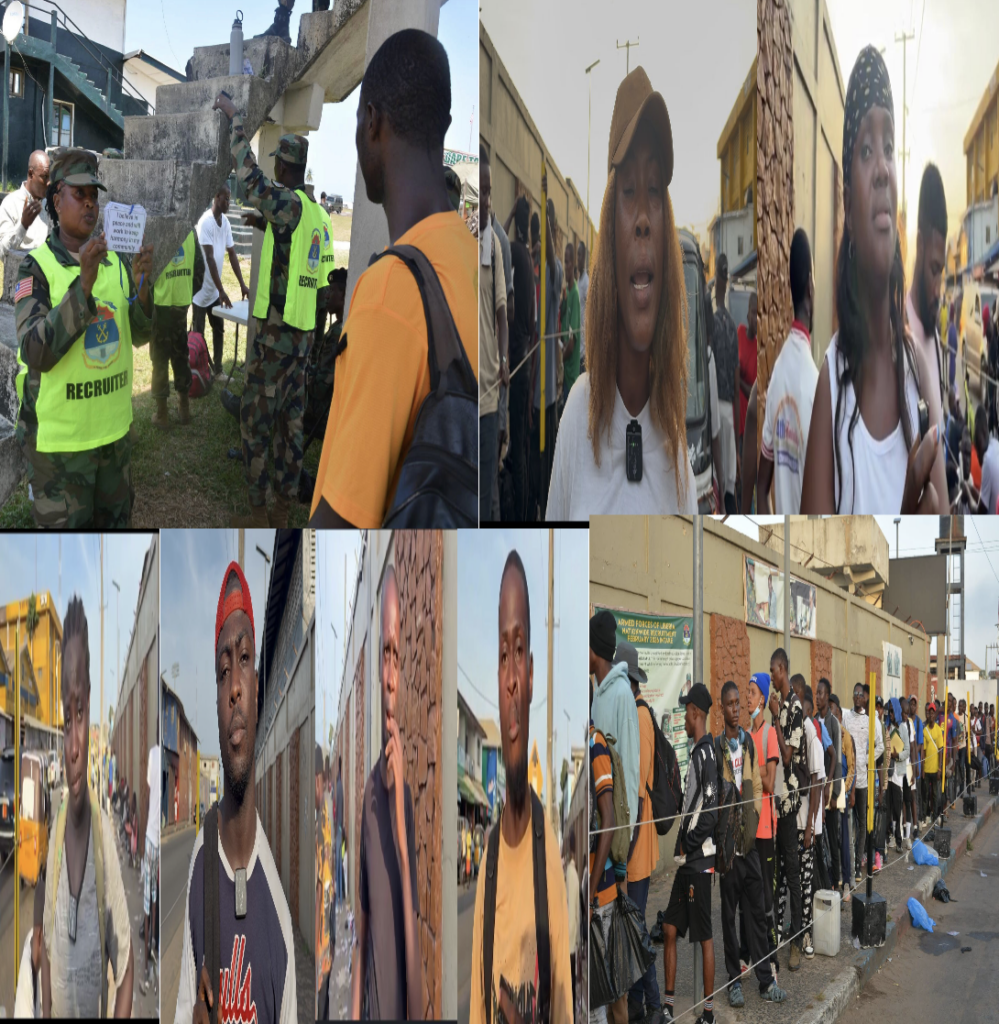
The AFL 2026 recruitment exercise officially commenced on April 27, 2026, and is scheduled to run through June 27, 2026. However, by April 24, 2026, a large crowd of prospective recruits had already gathered at the Barclay Training Center (BTC) barracks, with many remaining on the premises overnight. The first stage of the process revealed difficulties, as numerous applicants struggled and at times appeared unable to read short written sentences, which observers speculated were part of an eye and reading test.
This raised concerns among Liberians, with some blaming Liberia’s struggling education sector and others faulting the applicants themselves. During interviews with WomenVoices over the weekend, several applicants, including Ramona Ballah, appealed to the public to refrain from ridiculing those who appeared in viral videos struggling to read. “Joining the army is not easy. If someone makes a mistake, it does not mean they are uneducated. Sometimes fear can affect performance,” Ms. Ballah said.
Ms. Ballah, a registered nurse and graduate of the Smythe Institute, expressed a strong passion for joining the military and praised the professionalism of AFL personnel, describing the recruitment environment as calm and well-managed. Applicants who attended the exercise at the Barclay Training Center in Monrovia attributed the incidents to nervousness. “People are terrified. Not everyone reacts the same under pressure. It does not mean they are dull,” one applicant added, while encouraging fellow recruits to remain confident and trust the process.
Last week, exiled Liberian Martin Kollie offered his perspective on the underlying causes of the literacy challenges, following the situation. “Are you still asking why a lot of AFL applicants can’t read? A few greedy politicians pocket almost everything every year: Cape Palmas High School, US$20,000; Sanniquellie High, US$30,000; Frank Tolbert Public School, US$15,000; Entertainment for Speaker Koon, US$559,180,” Mr. Kollie said.
He further noted, “AFL applicants who are being denied because they can’t read, we’ll send them to adult literacy programs and night schools. We just raised US$500. Please reach out if you want to contribute. It’s our system that produced them as graduates. We can’t beat on them.” According to data from UNESCO and the World Bank, the overall adult literacy rate in Liberia is approximately 48.3 percent for individuals aged 15 and above, indicating that just under half of the adult population possesses basic literacy skills.
Literacy rates are significantly lower in rural areas at about 34 percent compared to urban centers, with a pronounced gender gap. The youth literacy rate for those aged 15 to 24 stands at 77.5 percent, suggesting improved access to education for younger generations.
With mixed experiences ranging from optimism to frustration, prospective recruits called on the government to increase budgetary support for the security sector, expand recruitment intake, and improve the pace of the process.
They cited unemployment and a passion for national service as key motivations for enlisting. Inez Togbah, a businesswoman from Ganta City, disclosed that her business had not been performing well, forcing her to explore alternative opportunities. Having spent four days at the Barclay Training Center, she noted that many applicants are turning to the AFL due to limited access to jobs across the country. She commended the government and humanitarian partners for providing food and water to those standing in long queues.
Another applicant, Caroline, a Montserrado-based businesswoman, described her participation as the fulfillment of a long-held dream. She revealed that she had previously applied during the administration of former President George Weah but was unsuccessful. She remains hopeful this time and praised the army for its patience and support. William Wise Sali Jr., a fitness coach, described the recruitment process as transparent and dismissed allegations that the AFL favors certain individuals. “Some people fail to meet the requirements and then claim the system is unfair. From my observation, that is not true,” he stated.
For Micarlos Peter, an electrician, joining the AFL is a personal choice driven by passion rather than unemployment. Although he acknowledged that the process has been slow, he urged authorities to accelerate the pace while encouraging fellow applicants to remain determined despite challenges.
However, not all experiences were positive. Anthony Menyon, a recent graduate, recounted being turned away due to documentation issues.
“I was embarrassed and I cried, but I will not be deterred,” he said, adding that he is working to correct the errors and reapply. Mr. Menyon called on AFL officials to consider conducting preliminary document checks while applicants are still in line to help identify errors early and reduce delays. Meanwhile, Jarret Harris, a contractor, emphasized his desire to serve the nation despite having stable employment and urged fellow applicants to remain focused and well-prepared, particularly regarding documentation.
Mr. Harris also called on the government to increase investment in the military. “When you visit military barracks, both in Monrovia and outside, the conditions are not encouraging. The government needs to allocate a non-negotiable budget for the security sector,” he stressed. Echoing similar sentiments, several applicants urged the government to expand recruitment intake, arguing that selecting only 600 candidates from over 1,000 applicants is insufficient given the country’s security needs.
The applicants further called for increased manpower, improved conditions within the military, and greater consideration during the recruitment process.
To be eligible to join the Armed Forces of Liberia, applicants must be Liberian citizens between the ages of 18 and 35 years. Each candidate must have at least a high school diploma and must possess a WAEC or WASSCE certificate. All applicants are required to be physically and medically fit and must provide a valid health certificate from a recommended medical institution, noting that the certificate must have been issued within three months of the application date.
Candidates must also be cleared of any human rights abuses or violations. Required documents include a National ID card, a Liberian passport, a birth certificate or certificate of naturalization, as well as two passport-size photographs with a white background.
The recruitment screening will take place across four regions. For Region 1, screening will be held at the Barclay Training Center in Monrovia from April 27 to May 15, 2026.
For Region 2, screening will take place in Tubmanburg City, Bomi County, from May 18 to May 29, 2026. For Region 3, screening will be held at the Gbarnga Sport Stadium in Bong County from June 1 to June 12, 2026. For Region 4, screening will be held at the Zwedru Multilateral in Grand Gedeh County from June 15 to June 20, 2026, and then in Harper City, Maryland County, from June 22 to June 27, 2026.
The recruitment drive comes one month after tensions escalated along the Liberia-Guinea border. For days, residents of communities along the Makona River in northern Liberia have remained in a state of heightened fear and uncertainty as a territorial dispute with Guinea entered its second week on March 17, 2026.