

– Former President Weah Asks, Reflects on Legacy, Sacrifice, and Service
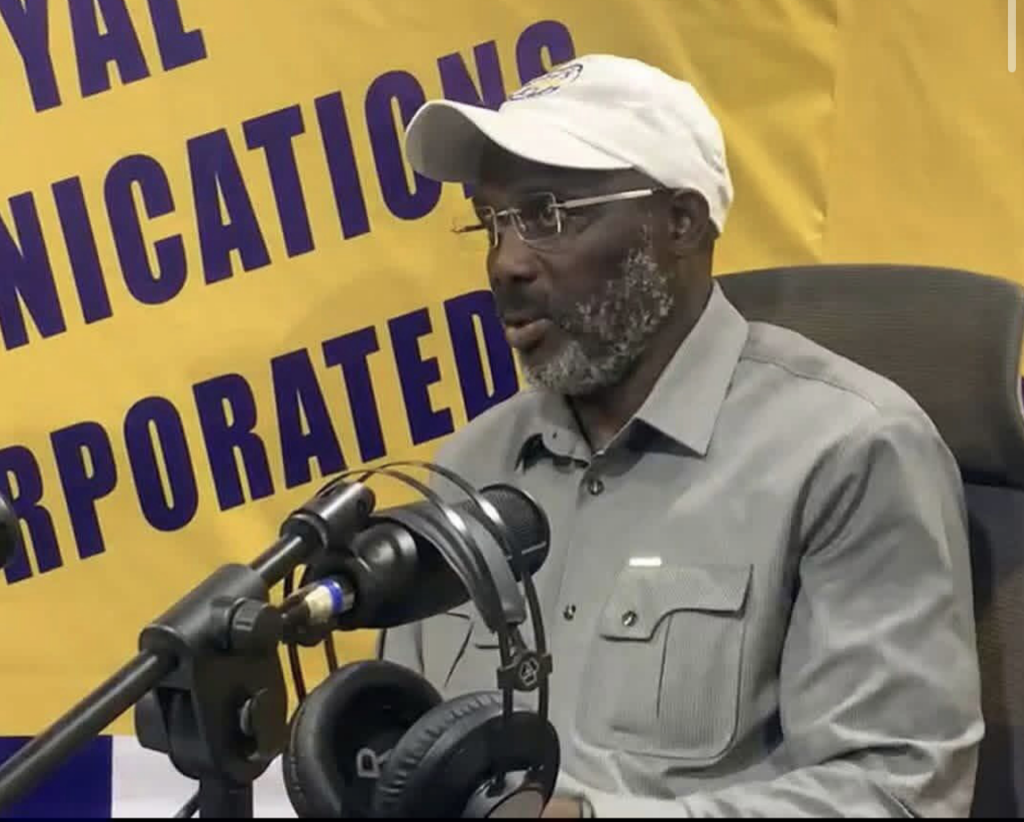
Monrovia –– Former President George Manneh Weah, speaking on Sunday at the official opening of radio and television stations adjacent to the Forkay Klon Church, questioned why he remains a target of public criticism despite what he characterized as a lifetime of personal sacrifice, educational investment, and clean governance.
In remarks that, Weah directly confronted his detractors by asking, “Why do people hate me?”—a question he answered by asserting that he had neither brought war to Liberia nor committed any wrongdoing against the nation, adding that his kindness toward others stemmed directly from the divine kindness he believes God has continually shown him.
Addressing persistent claims that he failed to contribute meaningfully to the University of Liberia, the former president pointed to a post depicting students riding on a truck and forcefully rejected the narrative, stating that he had personally purchased the first bus used by the university since 1847, a purchase he made while playing professional football for AS Monaco, long before he entered politics.
Weah went on to name several prominent Liberians whom he supported through private scholarships during their time at the university, including Nathaniel McGill, Samuel Tweh, Pepsi Yekeh, and Safua Mai Gray, and he argued that his contributions to the education sector extended well beyond undergraduate students to include aspiring doctors and lawyers who benefited from his financial assistance.
Turning his attention to Abraham Wheon, the manager of King’s FM, Weah issued a pointed directive in which he reminded Wheon that despite having served as President of the Republic, he would never take the Liberian people’s money to finance the station, and he insisted that Wheon must become a productive manager capable of developing the broadcaster without reliance on political connections or public funds.
Weah emphatically declared that he and his administration had never diverted public money for personal or political projects simply because they held power, adding that such practices are ones he has never engaged in and never will.
Reflecting on his personal history as evidence of his character, Weah recounted having broken his hand, his leg, his teeth, and his face over the course of his life, all of which he attributed to an unwavering belief in hard work and a personal code that forbids him from taking anything that does not rightfully belong to him.
The former president also addressed what he described as the unintended consequences of his own generosity, explaining to those present, including Nathaniel McGill, that the kindness he and his associates exemplified led some Liberians to mistakenly believe they were an inexhaustible source of wealth, when in reality they often sacrificed from very little and shared what they had, only to later be accused of hoarding plenty.
Weah concluded his personal reflections by distinguishing between material inheritance and moral formation, acknowledging that while he grew up with a hardworking and prosperous father who owned a mechanic shop and a nightclub, his true sense of reasoning and ethical grounding came not from his father’s wealth but from the values instilled in him by his grandmother.